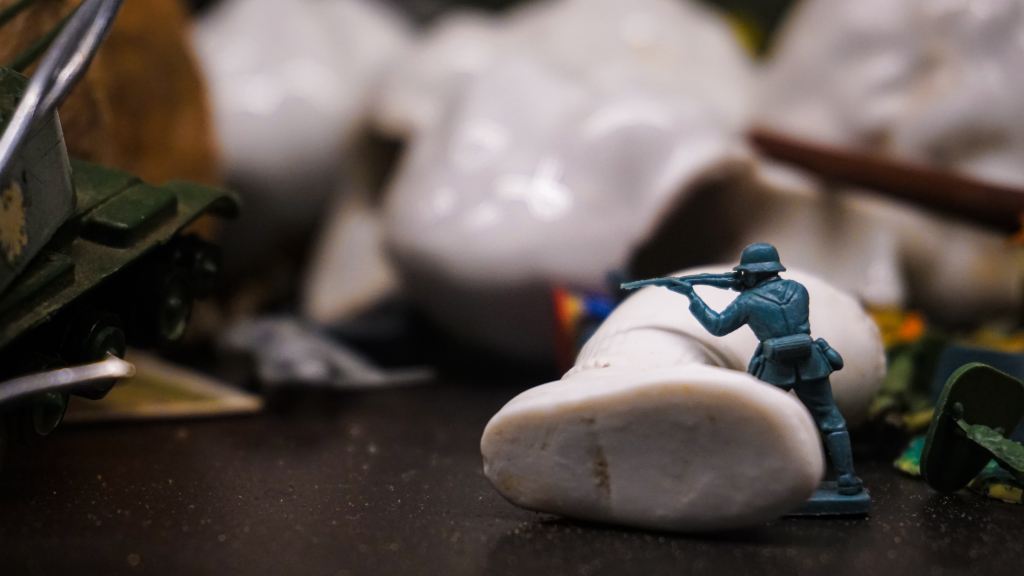
Les Newsom discusses the emergence of battle-related toys during certain European wars and why toys are often used to promote conflict.
In the months following Russia’s invasion of Ukraine in 2022, toy makers responded with products related to the conflict. Within a couple of months, fundraising initiatives were selling toy figures of President Volodymyr Zelenskyy built from Lego parts and kits to build miniature Bayraktar drones from toy bricks. Those with a softer choice in toys could buy a cuddly bomb-sniffing dog or an equally soft FGM-148 Javelin missile. Now in mid-2023, ranges of toy soldiers and toy tanks allow children and adults to play out the war in miniature. Many of these products are aimed at adults, intended to fundraise and highlight the plight of the Ukrainian people, as well as promoting interest in the conflict.
However, despite claims they are ‘collectable miniatures’, these are toys and therefore appeal to children who may see them online, in the collections of adults, or receive them as gifts. Through this interaction, the war is also promoted to children – possibly at a very young age, given the appeal of the soft toy dog. This appeal begs two questions surrounding the purpose of the toys. Firstly, are they merely a fundraising tool, or is the purpose to promote wider support of the conflict within the populations of those nations supporting Ukraine? And secondly, why toys? Some weapon-inspired toys may resemble the latest in military technology, but toys of military equipment and soldiers are nothing new, nor is their use as propaganda to encourage support for conflict by children.
Childhood has been a focus of state and military propaganda since the modern idea of childhood as a stage of life was invented in the late-nineteenth century – a period that also witnessed the rise of middle-class consumerism. Before the outbreak of war in 1914, British and German toy markets reflected the antagonistic political, economic, and military climate between the two European rivals. The German toy trade dominated both the British market and internationally, a challenge to British dominance in world trade that was highlighted by economic commentators such as E.E. Williams. When antagonism shifted to open war, British toymakers welcomed the ban on German imports allowing them to finally ‘capture German trade’, Meanwhile, their German competitors insisted that their work in educating young Germans had contributed to the large numbers marching to the front – and that the toy industry’s continued efforts were essential to the success of the German war plans.
Some weapon-inspired toys may resemble the latest in military technology, but toys of military equipment and soldiers are nothing new, nor is their use as propaganda to encourage support for conflict by children.
The German industry had products ready to meet an increased demand – toy soldiers and model ships, aircraft, and Zeppelins. The British industry, due to its limited size and dependence on German imports, had to improvise quickly, like how many Ukrainian-war themed products were quickly repurposed. Union flags were liberally applied to existing products using ‘sticker’ packs; children’s toy shops, post offices, and kitchens were rebranded as Little Army Shop, Our Forces Post Office, and a field kitchen.
Of course, children don’t need the exact toys to play at war. Toy soldiers in Napoleonic uniforms, Cowboys and ‘Indians’, dolls, and teddy bears all fought on a child’s imagined battlefield. In one example from The Times, a family’s nanny was horrified to find their nursery floor littered with headless dolls; asking the children what had happened, they responded there had been a ‘gas attack’. Evidently, they were aware that new weapons had been deployed, as were other children said to have used ‘stink bombs’ to feign gas attacks in the streets. Akin to the development in Ukraine-related products, specific toys were soon available as manufacturers responded to new aircraft models, tanks, and changes in battledress. Children could refight battles on the nursery floor using these toys and their imaginations.
In addition to children’s imaginations, board games offered other ways of defining the scope of play. Games allowed the children to plan the invasion of England, fight in the trenches of the Western Front, or sink ships with U-Boats. These games familiarised children with the progress of the war, battlefield tactics, and the anticipated outcome. Games also allowed children to participate in a fantasy version of the war.
Games based on the current war in Ukraine have not appeared yet, although a couple emerged after the annexation of Crimea in 2014. However, the invasion of Ukraine is relived in an improved manner via online apps such as World of Tanks and War Machine. The war is also being recreated by tabletop wargamers using toy figures and vehicles that are already commercially available. The moral uncertainty of using a violence as entertainment is hidden by claims of “trying to understand” the war or justified by the fact that the players are “veterans of the armed forces with a keen, personal interest in the conflict”.
Why are toys used to promote conflict? They are not the only commodities available, but they are some of the most widely available, alongside fashion accessories. Is it a purely commercial choice? The popularity of toys ensures high sales, and moral concerns go ignored by the profiteering demands of capitalism. Is it that conflict itself seems attractive and consumers wish to play at war? Or are toys and war intrinsically linked by our expectations for children and the driving forces of consumerism? Is it part of an intentional militarisation of childhood and normalisation of violence dating back to the late-nineteenth century and evident to this day? Or do children – and adults – choose to recreate their experiences of violence in an attempt to understand it?
Toys are not always as innocent as they seem. They can be a powerful tool of influence and communication on and by children and adults alike. Why do want to purchase a cuddly missile for ourselves or our children? What message does that send?
Les Newsom is a PhD Candidate at UCL’s School of European Languages, Culture, and Society (SELCS).
Image by Max Böhme on Unsplash.
Note: The views expressed in this post are those of the author, and not of the UCL European Institute, nor of UCL.
 UCL EUROPE Blog
Leave a comment