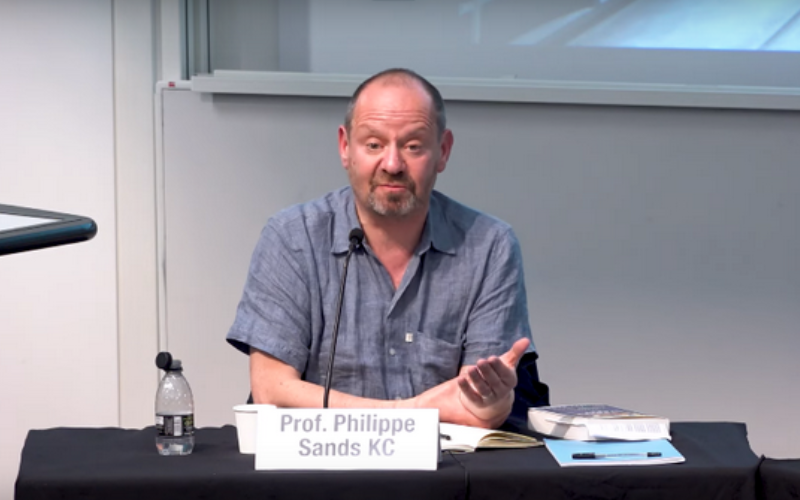
Aided by insightful questions from panellists Kimberley Trapp (UCL Professor of Public International Law and Deputy Dean of UCL Faculty of Laws) and Uta Staiger (Associate Professor of European studies and Director of the UCL European Institute) the audience was invited to consider how the legacy of the Pinochet case maintains relevance today, not least in light of recent discussions concerning the immunity of officials before foreign criminal courts.
For those that have not had the chance to read it yet, 38 Londres Street explores two distinct but interrelated stories: Pinochet, Chile’s former military dictator, facing trial in London and Walther Rauff, a fugitive SS officer in Chile fleeing prosecution. The book marks the third in what Professor Sands characterised as an “accidental” trilogy. Beginning with an invitation in 2010 to give a lecture in Lviv, Ukraine, more than a decade of historical detective work ensued, uncovering a series of previously unknown truths behind how Nazi crimes could be committed, on the one hand, and prosecuted, on the other. Whilst both Rauff and Pinochet evaded justice during their own lifetimes, Sands’s evidence and thorough analysis helps ensure their crimes will not be forgotten.
Indeed, as the panel skilfully illuminated, the story of Pinochet and Rauff’s confrontations with the law underlines several key messages relevant to promoting contemporary legal justice as well as a healthy civil society more widely.
Emergence and Maturation of Public International Law
In his opening notes, Sands stressed the historical significance of the 1999 Pinochet trial as a logical continuation of the crimes established at the 1945 Nuremberg Trials, as the first example of a former Head of State having his immunity waived before a foreign national court for crimes committed in an official capacity. In this way, Sands was adamant to emphasise, the case exemplifies the patience required in developing an international rules-based system, whereby principles may take many decades to crystallise.
This is more relevant now than perhaps ever before, with the fragile balance between immunity and impunity increasingly appearing to tip in favour of the impunity. Indeed, to many observers, international law appears unable to bring perpetrators to justice, with explicit violations of international law remaining unpunished. A case in point may be the seemingly insurmountable difficulties in executing the ICC arrest warrants against Putin and Netanyahu.
Yet, whilst persistent flagrant breaches of the rules against use of force, humanitarian, and human rights law may cause many to doubt the cogency of a rules-based global order, there are also reasons to remain optimistic. As Sands explains, such breaches mandate not abandoning the system but rather redoubling our efforts to ensure its survival. Just as Pinochet’s trial innovatively crystallised the Nuremberg principles, it is only by playing the long game that real progress can be achieved. Significantly, 38 Londres Street suggests, such change arises not through mechanical, dispassionate legal forces, but centrally through the tenacity, courage, and creativity of individuals determined to prevent impunity from prevailing. History reveals that retaining the “civil courage” to stick to one’s principles despite countervailing demands is ultimately the cornerstone of civil society, both in law and beyond. Whilst competing claims of legitimacy or moral responsibility cannot be straightforwardly resolved, we cannot abandon faith in the principles themselves. Rather, it is the responsibility of the individuals underpinning our institutions to continue to fight for what they see as right. In this way, Sands appeals to a large intended audience with an inspiring call to action for all, whether lawyers or not, to do what they can to promote and protect a rules-based global order.
A Special Tribunal for Aggression and the Significance of Ideas
On this point, to conclude the lecture, Sands treated the audience to a fascinating anecdote underlining this central message. On the back of a February 2022 article written for the Financial Times laying out the case for the establishment of a special international tribunal to investigate the crime of aggression for Russia’s invasion of Ukraine, Sands outlined the remarkable consequent collaborations which underpinned the recent announcement that a special tribunal will be imminently established within the framework of the Council of Europe. To Sands, whilst not starry-eyed about the political complexities involved in bringing Putin before any such tribunal, its establishment after the publication of his article provides a poignant case-study as to how the life of ideas, the life of talking, and the life of a university such as UCL are still alive, well, and resonant. Genuine progress may, and must, be sparked by propositions outlined in any medium.
For 38 Londres Street Sands drew upon the extensive and significant fiction written in the wake of Chile’s military regime to inform his historical investigation and present-day legal analysis. Where Chilean courts and academics feared to go in the 1990s, poets, novelists and creatives filled the void by writing stories about crimes and injustices. The links between literature and law, legal fact and fiction are inextricable, and integral to the health of a burgeoning rules-based order. Sands’s novel and lecture serve as an inspiring reminder of the undeniable significance to public international law – and to civil society as a whole – of supporting individuals to contribute ideas, in all manner of formats. His personal yet analytical account provides a beacon of hope that Nuremberg’s ambitions might one-day be achieved, alongside an instructive reminder of the role we can all individually play in realising this aspiration.
Philippe Sands is Professor of the Public Understanding of Law at UCL, visiting professor at Harvard Law School and a practising barrister at 11KBW. He has been involved in many significant international cases in recent years, including Pinochet, Congo, Yugoslavia, Rwanda, Iraq, Guantanamo, Chagos, the Rohingya and Israel/ Palestine. He is the author of Lawless World, Torture Team, East West Street (winner of the Baillie Gifford Prize for Non-Fiction) and Sunday Times bestsellers the Ratline and the Last Colony. He has served as President of English PEN and as a member of the board of the Hay Festival.
Note: The views expressed in this post are those of the author, and not of the UCL European Institute, nor of UCL.




Leave a Reply