
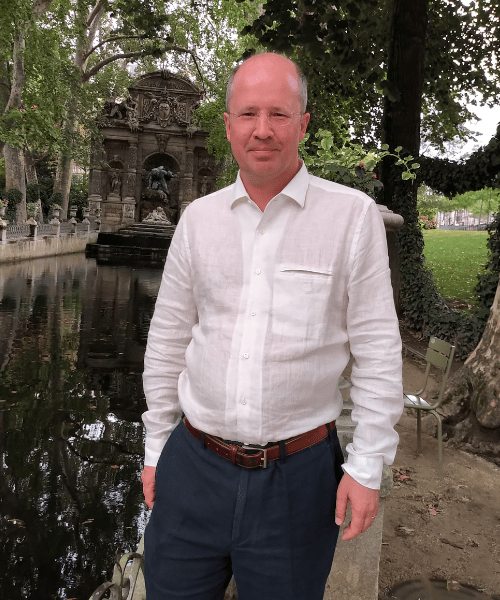
European Institute Student Ambassador Irini Tombazi spoke with UCL’s very own Dr Oliver Gerstenberg, senior lecturer in Law, about what drove him to pursue his career and how he stays motivated.
After many years of teaching, achievements (including fellowships at the European University Institute, Harvard, Princeton and the British Institute of International & Comparative Law, to name but a few), and a published book titled Euroconstitutionalism and Its Discontents, Dr Gerstenberg has truly become an expert in matters relating to European law and philosophy.
I was curious to hear more about his fascinating experiences and to get his insights on how one builds such a successful and meaningful career. Throughout the interview, I was especially inspired by Dr Gerstenberg’s focus on resilience, strength of will, morality and individual responsibility. Nourishing the right character and mindset is crucial for finding success is one’s career.
On challenges and recognition
Two aspects stand out as the most rewarding of Dr Gerstenberg’s career, the first of which relates to interactions with his students. These often help him assess his own thinking with “ideas in touch with contemporary sensibilities, sensitivities and with the thinking which students as the new generation represent”. For Dr Gerstenberg, it is a matter of constantly challenging himself and his ideas to stay progressive.
Secondly, with regards to his own publications, a sense of community emerges from people recognising your work: “When you see that your work has been read, has been taken up by others and has even been refuted by others saying ‘Oh, this guy is crazy!’, even that is an honour”, Dr Gerstenberg shares. It is “the idea of participation in a community of investigators, and especially one that is transatlantic and probably global” that makes the work worthwhile.
A central theme in Dr Gerstenberg’s reflections is that challenging oneself is crucial for success in any sector. The hard work and sweat ultimately pays off, be it through concrete rewards or mental and emotional satisfaction. From this perspective, challenging oneself becomes beneficial for creating a meaningful life. For Dr Gerstenberg, challenging himself resembles a “joint endeavour” to contribute from different foci of research to achieve a greater common benefit for the whole.
For Dr Gerstenberg, it is a matter of constantly challenging himself and his ideas to stay progressive.
Advice to the younger generation
People striving to follow a similar career path should be grounded in a specific domain of expertise to start with. However, this should be done without “losing sight of the broader normative ideas behind that”, Dr Gerstenberg suggests. For example, without losing sight of questions relating to the plight of disadvantaged people in a society, who are marginalised or living in poverty.
“Many of you – the younger student generation – are very privileged and you should turn that, not into entitlement, but into an opportunity to help others. Turn that into an opportunity to spread the privilege, so to speak, and for inclusion in a community of professional debate.”
Acknowledging that it can be quite overwhelming to engage with a whole new world or community at first, Dr Gerstenberg emphasises that cognitive dissonance is something which will stay with you for your whole life if you are good at what you do. While it may be destabilising, this feeling should be embraced. Being able to question and criticise your own thinking is important to succeed as an academic, so one must be patient. Dr Gerstenberg adds that it is a career advantage if you can show that you are a self-thinking person”.
The value of philosophical thinking
Curiously, Dr Gerstenberg reveals that he always wanted to be a philosopher, but “somehow ended up in law”, due to a certain discontent with the tendency of philosophy to be distracting and too disconnected from real-life practical issues. However, he admits that his background in philosophy has been professionally useful, helping him to see things from a different perspective:
Philosophy can help foster inclusivity of the legal order by creating a sensitivity for aspects, which often get overlooked in routine technocratic legal work.
But how can people with no philosophical background benefit from its professional value? The best way is to start with practical problems, such as whether Muslim women should be allowed to wear a headscarf in private employment. As Dr Gerstenberg shares, “these are eminently important, very concrete, practical issues, which raise deep questions of who we are, who we want to be as a liberal society, and what concepts such as liberalism actually mean”. If applied correctly, philosophy is more than mere self-indulgence and can be enlightening for routine legal questions.
Publications: The importance of resilience
Reflecting on what it was like to publish a book, Dr Gerstenberg compares his experience to the ancient Greek fable of Sisyphus. Having been condemned to push a big and heavy stone up a hill, the stone rolls down again every time Sisyphus makes it to the top, forcing him to push the stone upwards for all eternity.
Dr Gerstenberg adds that, while it is every academic’s wish to make some “sustained grandeur statement and bring their ideas into order” by writing a book, once it’s done, “you realise that you have created just as much disorder again”. But one should not be discouraged, as Dr Gerstenberg shares that it is less about defeat, but about “trying harder, trying it again, and understanding that you wish to contribute to a discussion. It is a constructive exercise”. Writing is not just “a one-person show or a sporty exercise to show how great you are, how clever or resourceful you are… It’s a way of making your argument better at every turn and rethinking it in fresh ways in the light of new criticisms and new experiences. It’s an ongoing exercise.”
In this light, failure looks much more manageable than it is usually made to be by our peers, or even ourselves. Instead of being something that defines a person, it should be seen as a challenge, as something that pushes you to improve. I think that this emphasis on resilience and determination as critical parts of a successful mindset is especially illuminating.
Any young person seeking a meaningful and successful career should take inspiration from Dr Gerstenberg’s approach to life and professional success. We should not see difficulties as obstacles, but as chances for personal improvement. We should be resilient, determined, compassionate and open-minded to go through life making the right choices.
Irini Tombazi studies Law at UCL. She is a Student Ambassador with the UCL European Institute.
Image credit: Photo by Unsplash in collaboration with Getty images.
Note: The views expressed in this post are those of the author, and not of the UCL European Institute, nor of UCL.




 UCL EUROPE Blog
Leave a comment