Dr Zoltán Kékesi’s essay forms part of the online exhibition “Compromised Identities? Reflections on perpetration and complicity under Nazism?”
Born in 1926 in Berlin, Günther L. joined the Hitler Youth at the aged of 11, despite the disapproval of his socialist parents. He stayed in the organization until 1943 when he eventually entered the navy. In 2012, he was interviewed by Luke Holland (1948–2020), a British filmmaker, for “Final Account: Third Reich Testimonies,” a collection of oral histories, recorded with men and women about their memories of Nazism, the Second World War, and the Holocaust. In the course of the interview, Günther L. does not shy away from the “hard work,” as he calls it, of responding to Holland’s insistent questioning.
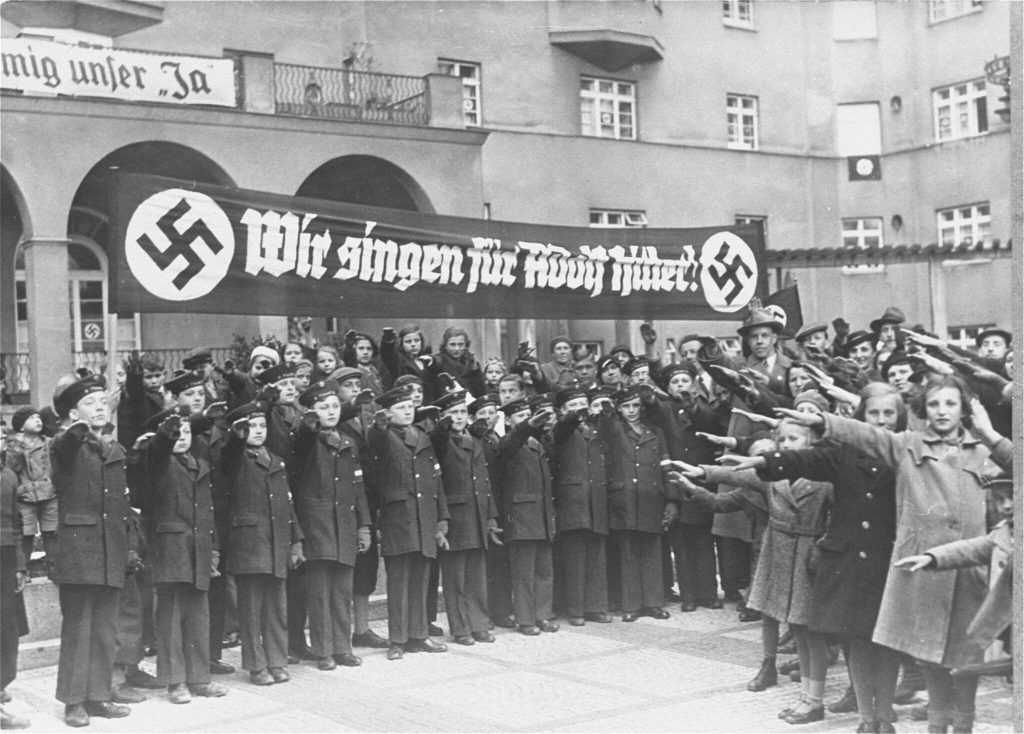
When recalling his childhood, Günther L. talks candidly about his enthusiasm for national socialism. His story illustrates the allure of national socialism for young people, and how Nazi indoctrination, “a multitude of small things,” as he says, permeated the everyday. National socialism established a cult of youth, and instilled in Günther L. and his peers a sense of mission. They were meant to become the harbingers of a new age, “the age of the young soldiers,” as one of their songs promised.

Indeed, children were the group most exposed to the lure of Nazi ideology. This is especially true for children born in the mid- to late 1920s, like Günther L. They grew up in a social environment dominated by established Nazi institutions such as the Hitler Youth and its female equivalent, the League of German Girls. By the time Günther L. joined the Hitler Youth, there was little dissenting parents could do to prevent their children from being brought into the Nazi fold.
In the following interview sequence, Günther L. relates the pride he felt as he finally received the Hitler Youth uniform and, even more, the dagger with the inscription on its blade: “blood and honor.” Decades later, he still recalls the songs of his childhood and the feelings they conveyed:
Günther L. is just one of the many in his generation with persistent memories of Nazi songs. Similar to him, the historian Helga Grebing (1930–2017) recalled in a memoir that she did not let her mother deter her from joining the League of German Girls. Seventy years later, the songs they learned to sing at the League “still buzz[ed] around in my head.”
*
Interviews in the collection “Final Account: Third Reich Testimonies” show how songs helped create a sense of community and commitment. Indeed, music formed an important part of Nazi education, and hundreds of youth ensembles were set up across the country to perform at public events. For “Final Account,” Luke Holland uses songs deliberately as a way to trigger memories. Songs and singing take interviewees back in time; and with the songs comes a multitude of experiences and personal histories.

As I was listening to some of the nearly 300 interviews in the collection, it struck me how much one particular song, the so-called Horst Wessel Song (or Lied, in German) the anthem of the Nazi party, acted like a Pandora’s box.
*

Horst Wessel was born in 1907 as a son of a prominent Berlin pastor and supporter of German militarism. Wessel joined the SA, the so-called Sturmabteilung or Stormtroopers, in 1926 and soon became the leader of a local unit. He operated in Friedrichshain, a primarily working class district that had been dominated by the Communist Party and became a battle ground between Communists, Social Democrats, and the Nazis. The Nazis treated physical violence as a propaganda tool, and the Stormtroopers were tasked to provoke confrontations with political opponents at meetings and on the streets. At the SA, Wessel grew into a skilled organizer and an agile leader in the fights on the streets. As a propagandist, he reworked popular military and folk songs into Nazi battle songs—including the song that would be named after him, the so-called Horst Wessel Song, in 1929. The first stanza read:
Raise the flag! The ranks tightly closed!
The SA marches with calm, steady step.
Comrades shot by the Red Front and reactionaries
March in spirit within our ranks.
By then confrontations grew increasingly violent, and in 1930 he himself was assassinated.
At Wessel’s funeral, Joseph Goebbels (1897–1945), regional NSDAP leader in the Berlin area and chief propagandist, envisioned a “reawakened” German people, soon to be marching in “endless columns.” In his speech he promised that “children in the schools, workers in the factories, and soldiers on the roads” will be soon singing Horst Wessel’s song. Released on record in the same year—and recorded anew again and again between 1933 and 1939—, the song soon became the anthem of the NSDAP.

By the time Günther L. and his peers learned to sing the Horst Wessel Lied, his native Berlin had become the site of carefully choreographed yearly commemorations of his death. The day-long ceremonies connected some key sites of Horst Wessel’s cult: his home in Friedrichshain (a district renamed as Horst-Wessel-Town), the hospital where he died (similarly renamed as Horst-Wessel-Hospital), and his gravesite at the St. Nicholas cemetery where members of his SA unit hoisted the Horst Wessel Flag. The ceremonies took place in the presence of Wessel’s mother and sister, high-level Nazi officials, honor guards, and members of the Hitler Youth and the League of German Girls. Invariably, they included roll calls, torch marches, wreath laying, the singing of the Lied, and ended at the Horst Wessel Square in Berlin’s Mitte (today’s Rosa Luxemburg Square). The same day, hundreds of similar ceremonies were carried out across the Third Reich, accompanied by press reports, radio programs, concerts, readings, and performances.
Indeed, Horst Wessel became a prototype and most popular embodiment of Nazi heroes. His cult prefigured a growing pantheon of fallen heroes, commemorated ritually in mass ceremonies, such as the annual rallies in Nuremberg and the parades in Munich where new members of the SS were sworn in. The 1934 Nuremberg rally was where Leni Riefenstahl (1902–2003) shot Triumph of the Will, that quintessential Nazi propaganda film, with the Horst Wessel Lied featured in the opening sequence. The tunes of the song ring out as Hitler’s airplane descends from a cloudy sky, and the viewer spots the expectant crowd below, waiting to be reunited with the Führer. By 1934, the song had become so popular that cinema audiences sang along spontaneously.
Nazi propaganda elevated the death of Horst Wessel to the status of quasi-religious sacrifice. By singing the song, Germans were meant to commit to imitate Horst Wessel, willing to die a martyr’s death for the Third Reich.
*
Prompted to sing it, interviewees in the “Final Account” collection exhibited a range of emotional responses, from remorse to nostalgia, from zest to refusal.
Born in 1923 in Ebensee, a small town in the Eastern Alps in Austria, Theresita K. remembers the songs of her youth fondly as they bring up memories of her father. A socialist “to the core,” he reprimanded her for singing the Horst Wessel Lied. Singing remained in her memory as an act of youthful revolt against her father. She smiles nostalgically as she recalls their one-time quarrel.
Herbert W. was born in 1931 in Vienna, he had an “impeccable voice” and was often tasked with singing at Hitler Youth events. Yet in the course of the interview, he refuses to sing the Horst Wessel Lied, even when prompted repeatedly. He stays deliberately within the confines of distanced narration and thoughtful commentary on a remote past. He seems to be aware that performing the song may show that the past is still inside him—in his memory, his voice, his body. And by singing the song, he may relive or revive a part of that past.
Born in 1925 in Butjadingen, a small German town on the North Sea cost, Gerda S. explains how her passion for singing played into her enthusiasm for national socialism. She has a straightforward manner of speaking and a strong voice; and when she talks about her school years there is remorse in her tone and accusation, as if to say: they did this to us, children. Yet, she refrains from portraying herself as innocent, as she reveals her own story of complicity in discrimination and blackmailing. She concludes: “That’s how we were, Germans.” When she sings, she means to openly demonstrate how they were.
Henri O. was born in 1924 in Alsace, France, to German-speaking parents, and the interview brings him back to a time when “we were German.” After Germany occupied the region in 1940, he had to join the Wehrmacht and he was eventually deployed to the Eastern Front. When asked what it meant for him to serve in the German army “as a Frenchman,” he sings the Horst Wessel Lied. “You play along,” he comments and recites the verse again: “The ranks tightly closed!,” as if to suggest that he had to comply. Instead of expressing adherence and the joy of cohesion, for him the verse is about coercion and submission.
Harry G. joined the local chapter of the Hitler Youth in Bella Vista, Paraguay, where he was born in 1924 in a rural community of German immigrants. He remembers that they used to sing when marching down the streets—but not the Horst Wessel Lied which was to be sung unter uns, at the closed meetings of the Hitler Youth. The songs and the uniform were signs of their membership of an exclusive organization. At the same time, they made them feel part of the “wide world,” a chance to “expand their horizon,” beyond their remote, struggling community.
Watching the interviews, I realized how much songs still linked, at the time of the interviews, these one-time “Nazi children”. The Horst Wessel Lied and similar songs opened the window to a multitude of memories no matter where they had spent their childhood, in Berlin, Belgrade, or Bella Vista. Moreover, many of these memories only seemed to surface as a result of them being prompted to sing.

*
Nazi songs left behind deep memories in the persecuted as well. In a 1997 documentary on the Horst Wessel Lied, Ralph Giordano (1923–2014), a German-Jewish journalist, recalled the moment when he first heard the song at the age of eight. While watching a violent clash between Nazi and anti-Nazi youth in his hometown, Hamburg, he witnessed one of the Nazi kids starting to “belt out” the Horst Wessel Lied. Despite being in danger himself, Giordano felt mesmerized by the song and the kid’s bravery. The moment remained “engraved” in his memory like a “snapshot,” he explained: “I have never forgotten it.” Giordano’s recollections testify to the routine violence even children carried out (and were exposed to) already in the years prior to 1933—a period called the “years of fight” in Nazi chronology.
“I will carry it in me all my life,” wrote Melanie Dewynter, née Loewy (1930–?), in reference to the Horst Wessel Lied, as she recalled the burning of Munich’s Orthodox synagogue during the “Night of Broken Glass” (or Kristallnacht in German), a 1938 pogrom. The Horst Wessel Lied was performed that night to conjure up a sense of militant or even mystical commitment and help initiate a turning point in anti-Jewish violence. As she walked down the street to the destroyed synagogue the morning after, she encountered an eerie silence that contrasted the tunes of the marches that had filled the streets the previous night.
*
Yet, the lure of national socialism was anything but “total,” and near-mystical commitment to it was not necessary for becoming complicit in the Nazi project.
Born in 1919 in Bregenz, Herbert F. joined the Waffen-SS, the military branch of the SS, in 1938, after Austria’s annexation to the Third Reich. He did so despite not being a supporter of national socialism, and in order to benefit of belonging to an elite organization. Unlike most of the participants in “Final Account,” around 1938 he was already a young adult with established political views. In the interview, he describes himself as German nationalist (deutschnational), a political current that promoted Austria’s integration into a “Greater Germany.” Yet, he did not envision the integration under the sign of the Swastika, and viewed the Third Reich from a sympathetic distance.
When talking to Luke Holland, he details his training in Dachau, adjacent to the concentration camp, and his experiences of being sworn in as member of the SS in nearby Munich on November 9, 1938. The event coincided—deliberately, as he emphasizes—with the Night of Broken Glass. While relating his experiences, he talks from the perspective of a somewhat detached participant. Instead of exhibiting much enthusiasm—or, indeed, regret—, his memories revolve around mundane details. For instance, he remembers the everyday routine of standing guard at the so-called Honor Temples and the Feldherrnhalle, the dull and strenuous moments of duty, rather than the kind of excitement that these “sacred” places and the night-time rituals were meant to elicit.
At the same time, when recalling the Night of Broken Glass, he expresses indifference to the burning synagogues. While being sworn in in front of the Feldherrnhalle, he remembers seeing the flames of the burning Orthodox synagogue. “I didn’t care,” he admits, “I had no feelings in me.” Despite his indifference, the sight imprinted on his mind, and decades later he remembered the details accurately: the ceremony started shortly past midnight, and the synagogue, located just a few hundred meters behind Feldherrnhalle, was set on fire at around the same time.
In his recollections, the Horst Wessel Lied plays a minor role which probably reflects his relative indifference toward Nazi ceremonies. In contrast, he becomes animated when asked about his military training and the songs they sang. When prompted to sing, his performance captures his passion for songs and his pride in military training and accomplishments. Certainly, songs carried a sense of camaraderie as well, and helped former members maintain a sense of community in their later life. In the course of the interview, Herbert F. produces a book, Songs We Once Sung, a cherished collection he keeps in his home library, published by a West German association of former Waffen-SS members in 1976. He came together with former Waffen-SS members every year up until the early aughts. No doubt, songs helped preserve old ties of camaraderie, cultivate ex-military memory, and embellish their war experience, or even glorify their one-time membership in the organization.
The following interview sequence sheds some light on the role of songs in military culture, experience, and memory. In this sequence, Herbert F. recalls an episode from 1945 when his unit was on a highway near Fürstenwalde, halfway on the short route between Berlin and the Oder River. The Red Army reached the river in January 1945 and halted there until April, when they started their offensive on Berlin. Exhausted, Herbert F’s troops were moving slowly—unclear if they were doing so east- or westwards, in order to face or to escape the Soviet troops. In any case, the episode probably became so memorable because singing provided a sense of composure in a moment of disintegration, desperation, and, ultimately, defeat:
*
Crimes committed by the Waffen-SS and other organizations were routinely accompanied by songs. Acts of violence—symbolic or physical—were often carried out in a festival-like, celebratory atmosphere, bolstered by rituals of singing.
In the closing sequence of a rather short and halting interview, while the interviewer is already wrapping up the conversation, Agnes M. unexpectedly returns to her experiences as a pupil at a German school and mentions singing. She was born in 1928 in Alsace, France, to German-speaking parents, and she joined the League of German Girls in the wake of the country’s Nazi occupation in 1940. A reserved interviewee, Agnes M. is suddenly reinvigorated when she sings two versions of the Horst Wessel Lied. The second has a modified opening line to accompany the burning of French textbooks. Instead of “Raise the flag” she sings “Raise the flame”, and recalls how members of the League of German Girls were tasked with taking schoolbooks to a nearby forest where they were then burnt:
*
Whether it came to symbolic acts of humiliation or mass killings, the use of songs was widespread. In Baden-Baden, Jewish men were arrested during the Night of Broken Glass, and forced to march to the synagogue where they had to witness its the desecration. As an additional act of humiliation, they had to learn and sing the Horst Wessel song. Many of them were then deported to Dachau. Similarly, songs were used in concentration camps and killing sites as well.
Born in 1925 in Vojvodina, a region of Serbia, then part of Yugoslavia, Maria A. grew up in Belgrade’s German community. Her recollections revolve around two turning points in her life: the German invasion of Yugoslavia in 1941, and her family’s evacuation to Vienna in 1944. Although she speaks about prewar life in the German community and her survival in Austria in the last phase of the war in detail, she omits the years between invasion and evacuation. By doing so, she passes over the story of her father, a photographer, who joined the 7th SS Volunteer Mountain Division, a unit that became notorious for atrocities committed against civilians while “hunting for partizans.” Beyond protecting her father’s memory, she hides her own involvement as well: her time in the Belgrade section of the League of German Girls. “We are easily swept away while still young,” she admits, hinting at her one-time enthusiasm.
In the closing section of the interview, Holland asks her why she was so unwilling to recall the songs they sang at the League, a seemingly minor detail. Suddenly, Maria A. opens up: she relates how they were made to sing the Horst Wessel Lied while marching in front of the hanged bodies of (supposed) partisans. She might be referring to the men who were tortured and killed by the Gestapo and hanged on light poles on Belgrade’s Terazije Square on 17th August, 1941. Local ethnic German units were then made to march by the dead bodies. Ultimately, the mention of the song prompts her to reveal a moment of shock which until then has remained unexpressed in the interview:
For her, the scene with herself singing and marching in front of the hanged bodies encapsulates her own involvement in Nazi crimes. She recites the line about the raising of the flag, and adds: “I was the flag-bearer.” Although she assures the interviewer that the photographs taken at the occasion were not made by her father, the scene probably forced her to contemplate what he may have been involved in, as well.
At the same time, her unwillingness to sing testifies to her rejection of her early enthusiasm for national socialism. While witnessing and, indeed, unwillingly assisting the killings, they “learned that all that is possible,” she says, all the cruelty. “And we had to sing a song, a song that I don’t want to ever hear again. Or recite again. […] No, I won’t ever recite that song again.”
*
For many of these interviewees, songs and singing were important for their attraction to Nazism. At least for historian Helga Grebing, they came to play a role in detaching from it. In her memoir, she relates her encounter with a group of Russian prisoners, forced laborers in a Berlin factory, toward the end of the war. She mentions the encounter as a memorable episode in what she describes as a “painful process of detachment from national socialism.” Previously, at the League of German Girls, Grebing had been trained to recognize “races”—even degrees of “racial mixing”—and to see Russians as “subhuman.” Still, as she saw the miserable conditions of the prisoners, she responded with a sense of empathy. Seeing her reaction, a German overseer set out to demonstrate that indeed “they were human beings like us.” At a sign from the overseer, “the Russians started to sing: the Volga Song,” an aria from a Franz Léhár opera. This song, she comments, “was able to deeply touch German souls as well.” Thus, her encounter with the Russian prisoners “became a component in my distancing from national socialism.” The fact that the prisoners had to sing and sing a German song—a song about fatherland, loneliness, and longing—to be seen as human attests to the role of songs in shaping the lives of these one-time Nazi children.
Dr Zoltán Kékesi is a cultural historian with an interest in memory studies and a focus on Central and East Central Europe.
He is a Research Fellow at the Centre for Collective Violence, Holocaust and Genocide Studies at the Institute of Advanced Studies, University College London. Here, Dr Kékesi is working on a collection of oral history interviews, entitled Final Account: Third Reich Testimonies.
This blog first appeared on Compromised Identities, the online exhibition reflecting on perpetration and complicity under Nazism. It is reposted with permission.
To learn more about “Final Account: Third Reich Testimonies,” visit UCL Digital Collections or watch the collection’s launch at The Wiener Library.
Zoltán Kékesi’s research has been generously supported by the Pears Foundation
Note: The views expressed in this post are those of the author, and not of the UCL European Institute, nor of UCL.
Featured image credit: United States Holocaust Memorial Museum, courtesy of National Archives and Records Administration, College Park


 UCL EUROPE Blog

Leave a comment