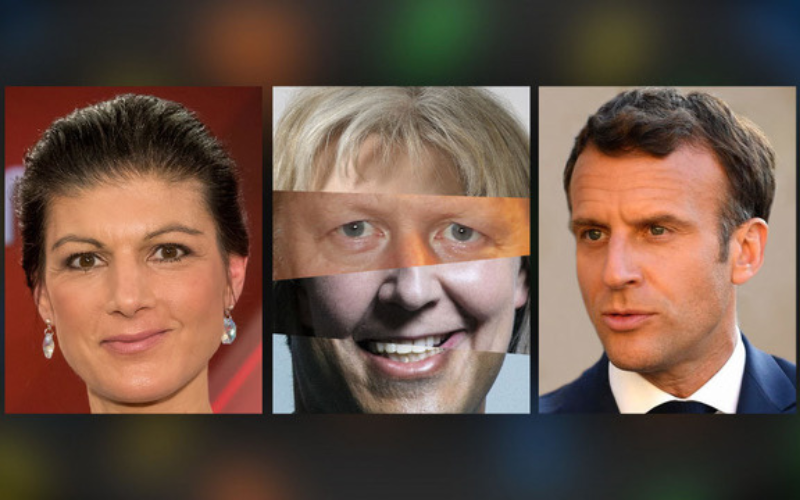
Allan Sikk and Philipp Köker challenge traditional distinctions between ‘new’ and ‘old’ parties, emphasising the importance of party people – electoral candidates – in understanding the complex shifts within Europe’s increasingly volatile party politics.
Political scenes across the European continent have been shaken in recent years. In many countries, new parties – many of them populist – have appeared while old ones have faltered or struggled to stay relevant. However, on closer inspection the new challengers often include well-known faces (e.g., Germany’s Bündnis Sahra Wagenknecht) while some formations that have campaigned under the same name for decades have changed their positions or personnel dramatically. This raises two questions: How new – or old – are these parties really? And how to make sense of them if neither the ‘new’ nor ‘old’ label fits them?
Party system change in Europe used to be relatively easy to study. Researchers and pundits could simply observe fluctuations in the electoral fortunes of parties over time. New parties, as rare as they used to be in Western Europe, did not complicate the picture much as they simply stole votes from established parties (and tended to be fairly small in any case). Party splits and mergers have always been a bigger problem, but they too used to be rare and rarely successful enough to bother scholars too much.
The emergence of new democracies in the east of the continent and the new party system in Italy in the early 1990s have gradually complicated the understanding of party system evolution. New parties frequently appear and often become remarkably successful; splits and mergers, often involving electoral alliances rather than political parties proper, abound. Summaries of results from successive elections sometimes seem to reflect different countries altogether or suggest a constant wholesale party system upheaval: for example, in many recent Latvian elections. This is not even a peculiar Central and Eastern European – or Italian – phenomenon. Electorally successful new parties and splinters are popping up across the continent, including in Western Europe: witness the turmoil in Germany’s party system brought on by the Alternative for Germany, the meteoric rise of En Marche in France, or the ongoing reinvention of the Danish party system.
However, things can get even more complicated than that. Many of these parties combine novelty and continuity; in other words, they are only partially new. Emmanuel Macron’s En Marche has become synonymous with a highly successful new party in Western Europe. Yet, only 34% of its candidates in its first parliamentary elections in 2017 were complete political novices. Such partially new parties have been common and successful in Central and Eastern Europe, but have always existed in the West, too, such as the Danish People’s Party in 1995 or Kadima in Israel in 2005. In contrast, parties can remain unchanged on the surface while undergoing significant change underneath: witness the bumper crop of new Tory MPs in 2019 or the current wave of Conservative MPs standing down in the face of looming electoral disaster.
To make sense of these complex developments, we must peek beyond party labels. As we suggest in our recent book Party People: Candidates and Party Evolution (Oxford University Press 2023), the study of party politics should take ‘party people’ – specifically electoral candidates – more seriously. After all, it is only a slight exaggeration to say that political parties are nothing without their people: nothing that parties ‘do’ could happen without the people ‘driving’ them. Looking at the turnover of candidates and their movement between parties not only allows us to trace the emergence of new parties and change in existing ones. It also allows us to gauge party novelty and their evolution over time, including links with various – possibly more than one! – predecessors or successors.
However, a candidate-based measure of party change can also shine a new light on traditionally stable parties and party systems not altered by major new party breakthroughs. The change among candidates can highlight sub-surface change in parties. In fact, shifting our focus to party people may reveal that parties once considered monoliths are less stable than previously assumed. Eventually, we may even find that the received wisdom that East European parties are unstable and Western European parties stable almost by default is an oversimplification. In Party People we find, among others, that several East European parties have experienced surprisingly little candidate turnover between elections.
Certainly, the writing is on the wall that the complexity of party politics is on the rise across Europe and is likely to be here to stay. But as parties and party systems change, so must our understanding of them. Embracing complexity and looking at the (party) people behind it should be the first step.
Allan Sikk is an Associate Professor in Comparative Politics at the School of Slavonic and East European Studies, University College London. His research focuses on European electoral and party politics, research methods, and political and social transformation in Central and Eastern Europe.
Philipp Köker is a Lecturer and Research Fellow in the Department of Political Science, Leibniz University Hannover. His research focuses on presidential politics, political parties and elections, and comparative constitutional law.
Party People: Candidates and Party Evolution (Oxford University Press 2023) by Allan Sikk & Philipp Köker is available as a hardback, e-book and audiobook on various platforms.
Please join the authors for a launch on 1 May at UCL SSEES.
Featured image collage by Allan Sikk of images of Rishi Sunak, Liz Truss, Boris Johnson, Theresa May, Emmanuel Macron and Sahra Wagenknecht, via Wikimedia Commons.
Note: The views expressed in this post are those of the author, and not of the UCL European Institute, nor of UCL.
 UCL EUROPE Blog


Leave a comment