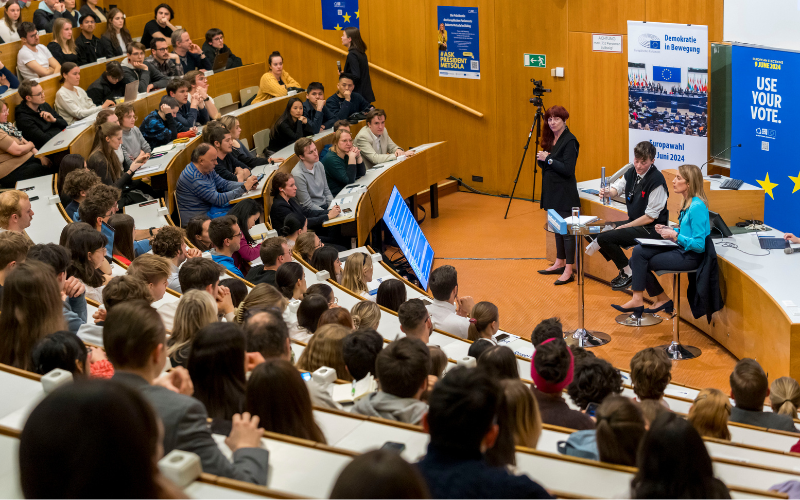
European Institute Student Ambassador Elena Sofia Massacesi interviews Tony Barber, European Comment Editor of the Financial Times, about the upcoming European Parliament elections, the potential for a Trumpian return, and advice for young journalists.
In light of the upcoming European Parliament elections, a recent ‘Policy & Practice’ seminar jointly hosted in March by UCL Political Science and the European Institute focused on what we can expect from the elections. Before participating as a panellist, I had the opportunity to speak with Tony Barber.
We started off by discussing the two hot topics currently in the media: the potential for a stronger far-right presence in the European Parliament, and the possibility of a second Trump term. Mr Barber emphasised that although there may be a stronger far-right presence, the European People’s Party and the centre-left parties will likely remain the largest parties in the Parliament. Even within the far-right, the parties are likely to often clash because of their nationalist ideologies that are inherently incompatible with cross-national collaboration.
If Trump were to be re-elected, Mr Barber believed it would be a strong morale boost for the far-right parties – but not much more. American foreign policy remains strictly separate from the European Union’s and, even within the EU, the European Parliament does not have the power to influence foreign policy issues such as aid to Ukraine or Taiwan. Rather, a rise in the far-right could have strong impacts on international trade, climate change and business regulation. The socio-economic hurdles facing the implementation of the European Green Deal – think the farmers’ protests last month – alongside cooperation with some centre-right MEPs could allow the European Parliament to gear the agenda towards more right-wing policies. Advancing member states’ commitment to the European Green Deal and future trade agreements may therefore be at stake.
We also discussed what a second Trump presidency could mean for Europe’s future security, especially given his recent anti-NATO rhetoric. Mr Barber remarked that it was too early to tell whether his comments had any real weight beyond being designed to scare European states into spending more on their own defence. If Trump is elected and goes through with this isolationist policy, Mr Barber expects that individual European leaders would plead with the Trump administration for help. Despite the recent spending increase of European states’ on military programs and training, years will pass before they can reap the fruits of the investments, so they remain vulnerable. It is thus difficult to imagine the prospect of NATO without the US materialising.
Though the potential rise of the far-right alarms many Europeans, Mr Barber believes that voter turnouts in states with historically low turnouts may not increase, or at least not by much, unlike in Poland’s parliamentary elections in October. Voters know that national governments hold the power over social issues, and turnout in member states with a historically low rate is unlikely to increase. Across the Atlantic, Mr Barber emphasised that the primaries system creates a structural problem within American democracy, favouring candidates who cater to the extremes. Nonetheless, Mr Barber remarked that shifts in the electorate are often due to social and economic shifts that occur naturally over time.
Our conversation then circled back to UCL and Mr Barber’s advice for students interested in a career in journalism. After graduating from university, Mr Barber began his career at Reuters in a role in which the main requirement was speaking two languages other than English. He stressed the importance of knowing multiple languages and consuming foreign media to not limit oneself to English, in addition to participating in internship schemes and writing for local publications, including university-led journals and magazines.
Finally, as we wrapped up our discussion, we delved into the history of journalism and its adaptation to the digital age. New media outlets such as Vice and Buzzfeed seem to follow a boom-and-bust cycle, but long-standing organisations that seemed in peril with the start of the digital age managed to reinvent themselves and continue their legacy into the 21st century – think the FT, The Economist, BBC, The New York Times, and other reputable non-English outlets. Mr Barber emphasised the importance of self-discipline and awareness whilst reading the news, especially checking links to see the primary sources of the claims. In this year of elections, that advice may be as important as ever
A video of the seminar on 14 March is available here.
Elena Sofia Massacesi is a student of Politics and International Relations at UCL and European Institute Student Ambassador. Her research interests include EU policy and environmental politics.
Tony Barber is European Comment Editor of the Financial Times. He is a former foreign correspondent in Austria, Belgium, Germany, Italy, Poland, the former Soviet Union, the US and the former Yugoslavia. In 2012 he was awarded the Medal of Gratitude by the Solidarity Centre in Gdańsk in recognition of his work in support of freedom and democracy in Poland. He wrote the introduction to Mud Sweeter Than Honey, a book on communist Albania by the author Margo Rejmer.
Featured image description: Town Hall discussion with young people during official visit by Roberta Metsola, EP President, to Austria ahead of the European Parliament elections in June.
Featured image Credit: European Parliament EP-167388A.
Note: The views expressed in this post are those of the author, and not of the UCL European Institute, nor of UCL.

 UCL EUROPE Blog
Leave a comment