
By Nino Haratischvili, translated by Charlotte Collins
This article was originally published by the European Literature Network.
Europe, where do you begin and where do you end? Where do your resolutions start, and how flexible are your boundaries? How much are you willing to give to protect those who share your values, and why do you prefer to turn your far-sighted gaze away? Where do you speak up, and where does your silence begin – a silence for which so many pay such a high price, one that you, Europe, do not have to think about?
This is why the outer periphery is outside, and this is why there is a periphery. It is there to protect your well-meaning, well-intentioned thoughts, so you will never again be haunted by nightmares since they are already busy haunting others.
Europe, how much blood must flow before you put your protective arms around us? How long can you go on convincing yourself that you don’t fight wars anymore? How long before you acknowledge that all you have done is outsource them? You let the people of the periphery, second-hand people, strive in your stead: for your humanist values, your environmentally friendly proposals, your social ideas, your noble undertakings, your benevolent mercy, and your humanity, hand-crafted in Brussels!
Europe, how many more stamps, signatures, agreements, objections, contradictions, changes, drafts, votes do you need to legitimate coming to our aid?
And how much longer must we wait? How many more packages of support will you send, consisting only of hope and optimistic words, until everyone starves to death? Because unfortunately we cannot survive on hope alone.

Europe, your periphery is melting, and the nightmares are scrambling over the ramparts. The world is tightening the noose around you. Because other countries are not as polite as you are. You practise your table manners with silver knives and forks, but for years now your huge, insatiable neighbour has been eating with his fingers and smacking his lips as the grease and blood run down his chin; he eats and eats, and, paradoxically, his hunger keeps on growing. The more he eats, the more he wants. For centuries he has suffered from a sickness that no one can heal, and the name of the sickness is fear of invisibility.
Europe, you are incredulous. How, you ask, is it possible that this neighbour, this giant, is so afraid? Why would he be tormented by such ridiculous doubts? But please believe me: this neighbour has lived next door to us for almost 250 years. He sits at our table, he eats our food, he lies down in our beds, he takes what belongs to us. Again and again he freezes our blood with his despotism; again and again he lets us charge at him head first, claw out his eyes, stab him with our knives; they are all mere scratches to him, he watches us do it and it amuses him, this masochistic Goliath. Because if he cannot be loved, he will settle for being hated. Anything is better than not being recognised. Anything is better than a politically correct lapse into obscurity.

What you deem good behaviour, Europe, he finds preposterous. Everything you consider worthwhile, he despises. He is laughing at you, Europe – and we are paying the price for his sarcastic, annihilating laughter, we who are condemned to live on your periphery and at the Goliath’s feet.
I know what I am talking about, and not from books, not from the news. I and countless others like me keep reliving this nightmare over and over again, as if someone has placed a curse on us and we can never wake up.
This neighbour, dear Europe, is not only big, strong, insatiable, and so self-destructive that nothing is sacred to him. Above all, he is everywhere you do not suspect him to be. He is in all the gaps created by your inaction, in all the places of your looking away. He is like gas: as long as it is not misused you do not smell it or see it, but one false move, one tiny spark, and the consequences are fatal.
Previously, yes, it may be that his methods were cruder, his hand unpractised; but he too has modernised, he too has learned. Because when it comes to effecting destruction and spreading hatred, he is unsurpassed. He buys people, buys entire governments; he installs puppets, he manages and controls, he’s a skilled puppet master now, this giant.
In 1991 and 1992, you dabbed the corners of your mouth with a white napkin and wondered where exactly this piece of land with the funny names ‘Abkhazia’ and ‘Ossetia’ was situated. He had already sunk his teeth into them and did not let go until they had been torn away from the rest: gaping wounds that never healed, interminable graveyards, streams of people driven from their homes, trekking across the mountain passes of the Caucasus in search of a new homeland.
In 1994 you’d just had your nails done – some important meeting, I imagine, I know you’re very popular and everyone wants something from you, I understand that this means you have to take care of your appearance, it must be annoying, all those petitioners, I’m certainly not judging you – when presumably you first heard of Chechnya. You shook your head: where is Chechnya, exactly? Isn’t it very far away? Then, in 1999, you heard the name again and were forced to hear it every so often for the next decade, because this little nation proved remarkably tough: it managed to hold out against the Goliath for ten whole years, that second time, until it was almost entirely obliterated. But by then you had long since formed your opinion of this nebulous and therefore dubious country, dismissing the ten-year war as an ‘internal affair’.

When, in 2008, you heard tell of Georgia – really bad timing, middle of summer, everyone in holiday mode – this was a country you didn’t need to search for on the map. You were even forced to cut short your holiday and intervene, to mediate, in your polite, well-brought-up way. And you were successful; and we thank you, thank you, thank you for that. But then, in retrospect, you called the invasion into question, wondering whether perhaps we had started the war against ourselves.
In 2014 we disturbed your peace again. This time it was Crimea: the giant had grown hungry again, edging uncomfortably close to you with his troublesome hunger. But who can make sense of that Slavic historical chaos, with all its entanglements, territorial claims and national egos; and so it was simpler, and smarter too, of course, not to get involved in the affairs of others, especially those of your uncivilised neighbours. And deep down – you’ll never admit it, which is all right, but – you thought it would be wiser to let the bloodthirsty monster have this peninsula, because then at least he would be appeased for a few decades. Or so you hoped. But this is precisely the mistake you’ve been making for centuries as far as the Goliath is concerned. The hope you harbour is false, and therefore fatal. He cannot be appeased, no matter how much meat you throw him, as if feeding a hungry predator. Because what motivates him is not the meat itself, it is the act of tearing it out.
In 2022, Europe, you could no longer look away. Stop your ears. Remain neutral. This could not be described as an internal affair. The war had advanced to your fringes, it was tightening the noose around you and pounding at your temples. This was not a patch of territory you had to search for, not some exotic country somewhere in the Caucasus, it was the vast expanse of Ukraine with its boundless wheat fields, just beyond your neat border fences …
Almost three years later the Goliath is still rampaging, still not sated, still not appeased. The apocalyptic beauty of destruction widens and widens in an atomic circle as the periphery melts away like icebergs in the Arctic.
Europe, we are bleeding. We can’t go on. We are either still at war or standing on the barricades, trying, with our last reserves of strength, to defend the things you taught us: democracy, freedom, dignity, life itself.

The killing continues in Ukraine, and for us, in Georgia, it is starting again. He doesn’t need an army this time: for a while now he has been training one up, quietly, effortlessly, in the background. It is the government that we voted in twelve years ago, and voted out at the end of October, but which refuses to be voted out and now seeks to paralyse us in the giant’s name, to silence us, lead us back into servitude; it is forcing us to the ground with teargas, rubber bullets, water cannon, beatings; it keeps on forcing us down, down, down, until we can no longer get up.
Europe, we need you to defend your periphery, what’s left of it. We need you, so that you can go on sleeping in peace. We don’t need napkins or silver knives and forks; we need catapults, Europe, because we, the Davids of this world, cannot hold out for ever.
So please, Europe, tell us, because we want to know: how many more sacrifices do you need for us to prove our love for you?
Nino Haratischvili, born in Tbilisi in 1983, is a multiple-award-winning novelist and dramatist and one of the most important authors of contemporary German literature. Her worldwide bestseller, the epic family saga The Eighth Life (for Brilka), was translated into numerous languages and nominated for the International Booker Prize. Her novel, The Cat and the General was shortlisted for the German Book Prize in 2018. Nino Haratischvili lives in Berlin.
Charlotte Collins is a translator of contemporary German literature. After studying English Literature at Cambridge University, she worked as an actor and radio journalist in Germany and the UK. Her co-translation, with Ruth Martin, of Nino Haratischvili’s The Eighth Life: (for Brilka) won the 2020 Warwick Prize for Women in Translation. Their translation of Nino’s most recent novel, The Lack of Light, will be published by HarperVia later this year.
Note: The views expressed in this post are those of the author, and not of the UCL European Institute, nor of UCL.
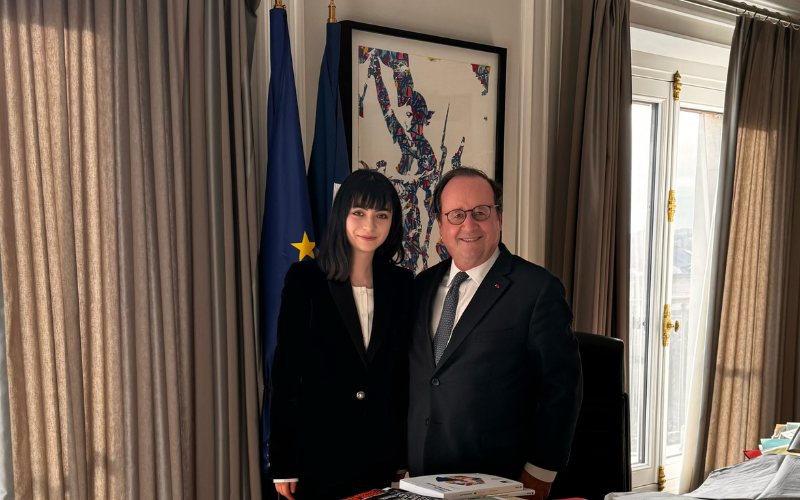
Image: Photo of Nino Haratischvili ©G2 Baraniak / Other photos ©David Pipia/JAMnews
 UCL EUROPE Blog
Leave a comment