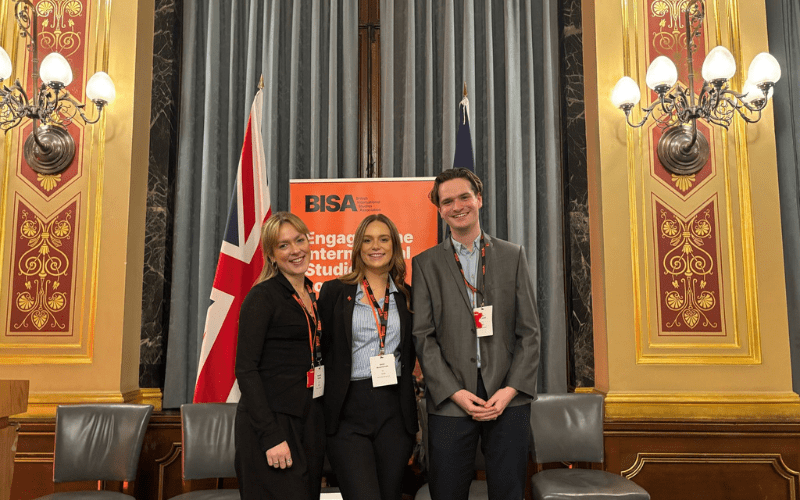
In February, Rory Ferguson, a Student Ambassador at the European Institute and MSc student in International Public Policy at UCL, participated in the Model NATO 2025 event. Organised by the British International Studies Association (BISA) in collaboration with the Foreign, Commonwealth & Development Office (FCDO), the event brought together students from across the UK to simulate NATO’s response to a major crisis. Below, Rory shares key takeaways from the day and reflects on the broader implications for the transatlantic relationship.
Last week, I had the opportunity, as one of nearly 100 students from 32 universities across the UK, to step into the grand halls of the Foreign Office, tasked with navigating the North Atlantic Treaty Organization’s (NATO’s) response to an international crisis scenario. Representing the member states, we had spent weeks preparing to step into the shoes of diplomats, generals, and policymakers. Our challenge? To coordinate NATO’s fictitious response to a series of earthquakes across the Mediterranean.
This high pressure simulation offered more than just a glimpse into NATO’s decision-making process- it became a real-time reflection of the dynamics shaping transatlantic relations today. With questions looming over burden-sharing, and America’s historic commitment to European security, as elaborated on by Kirsty Hughes on this blog, the way students approached the exercise revealed an intriguing snapshot of how the next generation of decision makers perceives the transatlantic alliance’s strengths and fractures.
As one of three students representing UCL, taking on the role of Türkiye at the event, I have two main takeaways from the day.
America’s Evolving Role in NATO
In the lead up to the event, one question dominated our team’s preparation: How will America respond? With Washington’s recent post-election shift in foreign policy, we were uncertain how the students representing the United States would approach the scenario. At first, their arrival at the Foreign Office, clad in unmistakable bright red ties, appeared to leave no doubt: MAGA had entered the room.
Speaking with them after the simulation, they reflected on a significant takeaway- few nations had actively sought out the U.S. for collaboration or support. The reason I note this as important is that throughout NATO’s history, the U.S. would have been the first stop for any alliance-building effort.
While interesting, this dynamic was likely shaped by students trying to interpret recent rhetoric. We had watched Trump’s unannounced phone call with Putin unfold, and watched Vice President J.D. Vance take to the stage at the Munich Security Conference to deliver a scathing critique of Europe. By the time the NATO day kicked off, it seemed many students had already internalized the idea that the United States was less of a reliable partner.
The Role of Middle Powers
With the United States offering little in the way of leadership, the day quickly became dominated by middle powers stepping into the void.
As UCL’s delegation, we had the unique opportunity to represent Türkiye, a role that required us to adopt a new geopolitical perspective. Our aim was clear: Türkiye should be seen as a serious and committed leader in NATO’s response, setting a strong precedent for generosity in any alliance-led disaster relief effort. In preparing for the simulation, we recognised that the visible rift between the U.S. and Europe could work to our advantage.
Given Türkiye’s sizeable military and strategic positioning, we saw an opening to act as a bridge between Europe and the United States. Throughout the negotiations, other nations- including the United Kingdom and Canada- also stepped up, working with the U.S. to ensure adequate support reached the crisis hit mainland Europe.
Stepping back, this shift in leadership within the simulation mirrors real-world calculations being made by governments across the globe. If the U.S. is truly retreating from its historically dominant role on the world stage, it creates a significant opening- one that ambitious middle powers will be eager to fill. While this redistribution may create new opportunities, it also raises uncomfortable questions about NATO’s long-term ability to respond effectively in moments of crisis.
What does this all mean?
The NATO simulation provided a revealing glimpse into how future policymakers perceive transatlantic cooperation. While in this scenario, the U.S. played a subdued role, prompting middle powers to step up, this shift would represent a net loss for NATO’s crisis response capabilities.
Beyond the simulation, Europe faces a pressing dilemma: how to adapt to evolving U.S. rhetoric around commitments. I write this on the day that the UK has increased defence spending, funded by cuts to international aid, underscoring the difficult trade-offs ahead. The key question now is whether Europe can- and will- take greater responsibility for NATO’s future.
Rory Ferguson is one of the 2024/25 Student Ambassadors at the UCL Europe Institute and a postgraduate student of International Public Policy at UCL. With an undergraduate degree in economics, his interests lie in the intersection between economics and policy. He is particularly interested in the ever-evolving relationship between the United Kingdom and the European Union.
Note: The views expressed in this post are those of the author, and not of the UCL European Institute, nor of UCL.

 UCL EUROPE Blog
Leave a comment