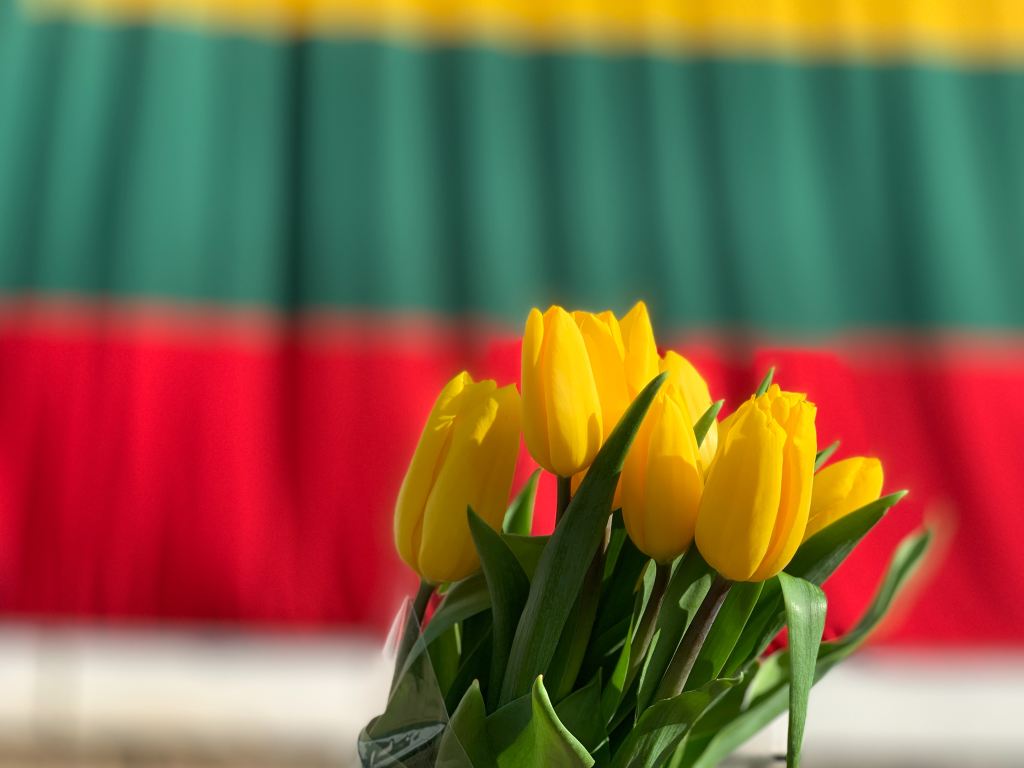
Unlike Poland or Hungary, Lithuania is rarely discussed with reference to Euroscepticism. However, based on interviews with Lithuanian politicians and political scholars, undertaken between March and April 2023, Egle Daunoraite’s research shed light on the covert and nuanced nature of Lithuanian Euroscepticism.
Written by Egle Daunoraite who studies BSc Politics and International Relations at UCL.
LGBTQ+ vs family values
While there has been a substantial overlap between European and Lithuanian values in part due to Lithuania’s desire to distance itself from its Soviet past, the issue of LGBTQ+ rights continues to remain controversial. As Lithuania only gained independence 33 years ago, the transition from life in the USSR – where LGBTQ+ rights were nonexistent – to being an inclusive society, has been a challenge. During the struggle for independence, some values took precedence over securing rights for marginalized groups. One of my interviewees illustrated this with a comparison to the UK:
Let us take the UK in 1978 33 years after WWII <…> This reveals that the same Western society 33 years after WWII was quite socially conservative and I think that homosexual relations, if not criminalized at all, were intolerable and marginalized. And compare with a society which became free 33 years ago and was in the Soviet Union where homosexuality was criminalized <…> so ours is even better, much better than it was with them [the UK]. So, the development of society should be compared from a certain starting point, we have much more Europeanization and liberalism than they had at the same point.
All the politicians I interviewed acknowledged the need for further improvements in promoting ‘European values’ and recognized the ongoing progress in encouraging public debates about these values. However, one respondent pointed out that Lithuanian Euroscepticism was more pronounced in 2004, when the country joined the EU. This sentiment was exemplified by the adoption of the ‘Law of the Republic of Lithuania on the Protection of Minors from the Negative Effects of Public Information’ in 2009, which, as the politician described, marked the peak of Euroscepticism in Lithuania. The law prohibits the dissemination of information deemed harmful to those under the age of 18, including about homosexuality and anything that contradicts the dominant understanding of family values as outlined in the Lithuanian constitution.
Different opinions on LGBTQ+ rights in Lithuania create divisions between people, giving politicians an opportunity to exploit this for their own gain. A political populist movement that promotes traditional ‘family values’, called ‘Lithuanian Family Movement’, established only 2 years ago, was frequently mentioned as an example. They claim that the EU pushes unwanted values on Lithuania, namely the concepts of ‘gender ideology’ and ‘LGBT propaganda’, which are still regarded as not ‘common or traditional for Lithuanians’.
Euroscepticism = democracy
Euroscepticism isn’t about a categorical rejection of the EU. Some respondents deemed it essential for holding the EU accountable. It prevents the population from becoming a society described as ‘ideal’ where everyone thinks the same way, aligning themselves with ‘one truth’. Indeed, Euroscepticism was described as an ‘expression of democracy’ by one of my interviewees:
Euroscepticism is present in every EU country, and it’s not necessarily a negative thing when it leads to balanced discussions with valid arguments. People often view Euroscepticism through their personal perspectives. While it’s natural for individuals to have preferences and even feel disgruntled with certain EU decisions, this is inherent in democratic societies. A democracy doesn’t require everyone to agree with every government decision; rather, it encourages debate and growth of society as a whole. Some people may express dissatisfaction with the EU, but many also benefit from the opportunities and values it provides.
Some of my interviewees emphasized that in Lithuania, there is a common perception that anti-Western views are often encouraged or come from people who hold a pro-Russian position or nostalgia for the USSR. However, there was a broad consensus among those I spoke to that Euroscepticism was more prevalent in Lithuania when the country first joined the EU – precisely because memories of the Soviet era were still fresh. Some viewed EU membership as potentially compromising their newly regained independence, leading to comparisons between EU institutions and Moscow.
A prominent politician compared the top-down approach of EU directives with USSR dictates:
Well, there are certain parallels that those directives that are dropped are often imperative, my generation or even older people can feel that they are similar to the ones that were directed from Moscow.
The war in Ukraine and the (re)embracing of ‘Europeanness’
Some of my interviewees noted that at the beginning of the war in Ukraine, Baltic countries held a different position towards Russia from the rest of the EU. From the onset of the conflict, Lithuania and other Baltic countries were advocating for more and harsher sanctions against Russia while West European countries were more reluctant due to their dependence on Russian gas.
The war effectively tempered Eurosceptic attitudes both in Lithuania and in the rest of the EU because, according to another interviewee, it “gave a certain slap in the face to those sceptics as they were denying an obvious threat”.
It became clear that Russia’s long-standing aggression towards Ukraine played a crucial role in reinforcing Lithuania’s Western European identity. In 2014, when Russia first attacked Ukraine, many Lithuanians recognized ‘that there is no other geopolitical orientation than the West’ for their country. Consequently, as one of my interviewees put it: ‘there is less and less space for them [pro-Russian politicians] <…> they are no longer seen as rational politicians <…> voters will choose more responsible politicians.’
Overall, Euroscepticism in Lithuania remains covert and issue specific. Even though there is some public opposition towards certain EU social values, especially regarding gender relations and LGBTQ+ issues, most Lithuanians strongly support Lithuania’s position as an EU member state, as well as the wide range of civil liberties it offers. My research also demonstrated the consolidating impact of Russia’s war in Ukraine on Lithuania’s (renewed) appreciation of its EU membership.
Egle Daunoraite studies Politics and International Relations at UCL.
The views expressed in this post are those of the author, and not of the UCL European Institute, nor of UCL.
Image credit: Justina Pakalnytė.
 UCL EUROPE Blog
Leave a comment