
UCL student Dora Fidler reflects on her experience as a student volunteer at the 2024 European Writers’ Festival
Over Easter, UCL emailed students on my course with an opportunity to apply to volunteer behind the scenes at this year’s European Writers’ Festival. What with my ambition to one day be a writer, and the knowledge that this ambition is shared by most of the people on my Creative Arts degree, I replied immediately, and my speed paid off.
My classmate Kay Lynn and I were added soon after to a group chat comprised of the team running the entire festival – professional, very important, paid adults. This included members of the European Union National Institutes of Culture (EUNIC) London, the Head of Literary Events at the British Library, and former BBC journalist and Director of the European Literature Network Rosie Goldsmith. Suffice to say I started paying closer attention to my WhatsApp notifications.
This year marked the second edition of the festival, which took place at the British Library. Rosie Goldsmith invited authors from across Europe to take part in panel discussions on topics ranging from their respective literary works to the relationship between Europe and literature and the way that culture and history influences their writing. This year’s theme was ‘Transformation’ and thirty authors, including poets, playwrights, short story writers, and novelists, spoke at the festival over the course of the weekend.
I arrived at the British Library at half past ten on the first day and was given the job of directing the writers, their guests, and the presenters chairing the panels to the green room. At the term ‘green room’, I swelled with a feeling of importance and exclusivity as images of airport business-class lounges and fruit bowls filled my head. The reality of the room, sequestered behind wooden double doors at the back of the British Library, was less glitzy than imagined – coats piled on every chair, no fruit bowls and one writer vaping away in the corner. And yet, as the day went on and the room continued to fill up, it began to hold within it a buzz and ambience seemingly at odds with its ordinary four walls, with a soundscape of tens of overlapping languages, from French to Catalan, Danish to Turkish, reaching fever-pitch as the authors discussed, plainly, literature and their passion for it.
Notable writers included Anne Berest from France (whose novel/family memoir/work of auto-fiction, The Postcard, I’d read in January and subsequently fangirled at her name on the programme) and Emma Dabiri, columnist for The Guardian and Elle magazine, representing Ireland with her book, What white people can do next. They were joined by the esteemed Ukrainian writer and journalist Andrey Kurkov, who closed the first day of the festival in conversation with Guardian international correspondent Luke Harding about his book, Our Daily War. It was the literary equivalent of Eurovision, minus the competition and the singing.
My other job at the festival involved social media and Kay Lynn and I alternated shifts sitting in the back of the auditorium during the panels, taking notes. I used my notes app to jot down compelling quotes from authors to be shared on Twitter and Instagram.
In a panel discussing transformation through translation, Catalonian poet Jordi Larios said: “You’re writing in a language on the edge of extinction… the very fact that you decide to write in Catalan is a political decision.” Another author, Spanish writer Elisa Victoria, remarked in her panel on the transformation of Europe and its relationship to storytelling: “I was afraid to forget it so I put it in a book.” And life seemed to imitate art as I hurried to copy the quote down word-for-word, so it too wouldn’t disappear into the ether.
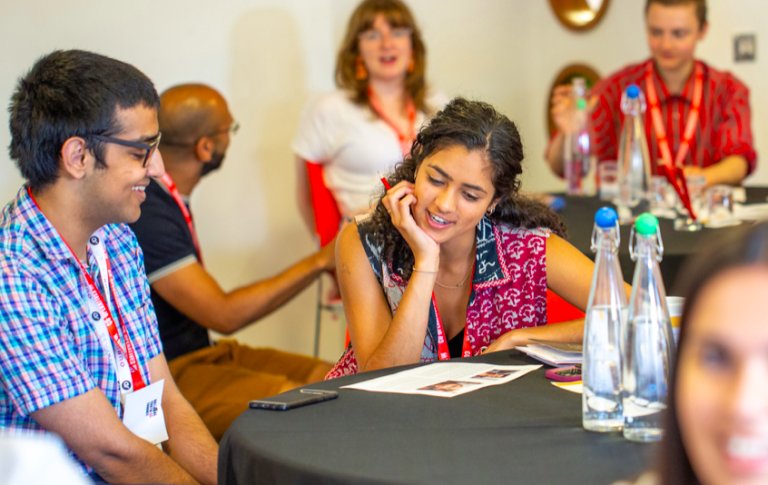
During the quick fifteen minutes in between panels, I ushered the public to and from the theatre and directed them to the toilets. The only thing stopping them from thinking I had no business telling them what to do was my special European Writers’ Festival t-shirt which suggested I had some authority and probably wasn’t as young as I looked. I interviewed a few of the writers in order to post reels of them talking on Instagram.
At the end of one such interview Bulgarian writer and UCL European Institute writer in residence Joanna Elmy smiled at me encouragingly and said I was doing a good job. Elmy, author of the novel Born of Guilt, which she would be discussing later that day during a panel on ‘Change and Conflict’, knew I was a student volunteer. The previous day, I’d followed Elmy, as well as other writers from the festival and members of UCL’s European Institute, as we walked ‘the European Literary Map of London.’
The walking tour was part of UCL’s partnership with the festival and brought us to areas around the university with notable literary history. Elmy’s contribution, on the Bulgarian writer Asen Khristoforov, took place outside where he’d lived and written in London in the 1930s. This happened to be opposite my own first-year university accommodation, a happy coincidence which filled me with a sense of connection to the centuries-long literary history of Bloomsbury.
If I took anything away from my experience working at the festival, it was that running such an event is no mean feat. Conversations were already happening about ideas for 2025 during the clean-up on Sunday evening after the last authors and members of the public had left. But I also learned that literature exists outside the limits of language. Through translation and shared affection for books, conversation upon conversation was had between writers from thirty countries across Europe. And though many of these conversations were watched hungrily by panel audiences, most took place, over the gentle clinking of china and the humming of the water cooler, in the green room.
Dora Fidler is a second-year student on UCL’s BA in Creative Arts and Humanities.
Her experience as a student volunteer comes in the context of UCL European Institute and UCL Arts & Humanities’ partnership with the European Writers’ Festival.
Featured image description: Panellists on stage at the European Writers’ Festival with a projector title screen reading ‘Change and Conflict’
Note: The views expressed in this post are those of the author, and not of the UCL European Institute, nor of UCL.
 UCL EUROPE Blog
Leave a comment