John Peet
Few European leaders have welcomed Donald Trump’s election victory in America (a notable exception being Hungary’s Viktor Orbán). That he will control not just the White House but also both houses of Congress and, in effect, the Supreme Court can only make them more concerned. An unconstrained and vengeful President Trump, with no worry about securing a second term, could quickly become a nightmare for Europe, in three broad areas.
The first and most urgent is geopolitics, particularly Europe’s future security. Trump’s obsessive view that other NATO countries are not spending enough on defence, making America bear an unfair share of the burden of protecting Europe, is well-known. So is his conviction that he can and will end Russia’s war in Ukraine on day one of his presidency. Not surprisingly, many in Europe have concluded that Russia’s Vladimir Putin may be the biggest winner and Ukraine’s Volodymyr Zelensky the biggest loser from a second Trump presidency.
Yet this may prove too gloomy. Since Trump’s previous term, most European countries have substantially increased their military spending (Poland now plans to spend a whopping 5% of GDP on defence, a bigger share than the United States). America’s switch of focus towards containing China has also long been clear. As for Putin, it is true that Trump likes strong leaders, even when not democratically elected. But he also hates losing, and a Russian victory in Ukraine would be a big defeat for America. What is obvious is that a second Trump presidency means that Europe must do much more to defend itself.
A second area of worry is climate change. Europe has long been a pioneer both in recognising the reality of climate change and in doing as much as it can to fight it. Yet Trump’s scepticism over climate change was evident in his first term, when he unilaterally pulled out of the Paris climate-change agreement, and it is not going to change. He is likely again to withdraw from the Paris agreement early in his second term, and he is already promising to “drill, drill” for more oil and gas. The mood of climate activists at this week’s COP 29 summit in Baku has darkened.
As it happens, America has recently been decarbonising its economy almost as fast as Europe, and despite Trump’s climate scepticism it is likely to continue doing so. The big driver is the inexorable decline in the price of renewable energy. Yet what may still be a worry is the message a second Trump presidency sends to the other big carbon emitters, especially China and India. Combined pressure from the West had helped these countries take climate change more seriously. That pressure will be sharply diminished under a second Trump presidency.
The third issue that concerns Europe is trade and the economy. Trump has often proclaimed his belief that “tariff” is the most beautiful word in the dictionary, and during his campaign he promised to impose tariffs on European exports of 10-20% and on Chinese exports of as much as 60%. For some such measures he may need congressional approval, which will not be automatic even if the Republicans control both houses. Lawsuits in American courts could also be an obstacle. Yet the president has remarkably broad authority to impose trade tariffs on security grounds, so Europe is right to expect him to do just that.
Both experience and mainstream economic analysis confirm that trade wars are bad for everybody, including those who start them. Higher inflation and lower growth can therefore be expected on both sides of the Atlantic, aggravated to some extent by efforts to tighten up on immigration. Even so, there are reasons to fear that Europe will lose out more than America from a tit-for-tat imposition of trade tariffs. Europe is more exposed to global trade than America, and it collectively also has a large trade surplus. Moreover the European economy is notably weak compared with America, largely because Germany is doing so badly.
A footnote to this concerns post-Brexit Britain. Some claim that Trump, who supported Brexit, favours Britain over the European Union, to the extent of exempting his British friends from any trade tariffs and even actively promoting a bilateral free-trade deal. Yet the reality is that such a trade deal is unlikely to materialise, and that Britain will be a big loser in any trade war. Indeed, if the second Trump presidency accelerates the formation of rival and competing global trade blocs, Britain may suffer more than most. Even those who believed in Brexit may have to accept that, with another Trump presidency ahead, it may have happened at the worst possible time.
John Peet is Associate editor at The Economist and a member of the UCL European Institute’s Advisory Board.
Note: The views expressed in this post are those of the author, and not of the UCL European Institute, nor of UCL.
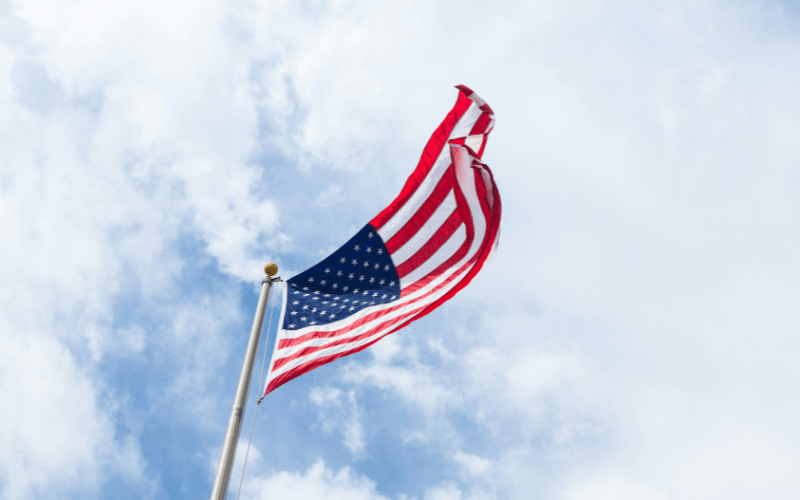
Featured Image: flag of the USA with a flagpole by Brandon Day on Unsplash


 UCL EUROPE Blog
Leave a comment