Richard McMahon & Zhaoxin Li
This article forms part of our series on perspectives from across UCL and beyond on the changing geopolitical order, and the implications for Europe, the European Union and the EU-UK relationship. Find more articles here.
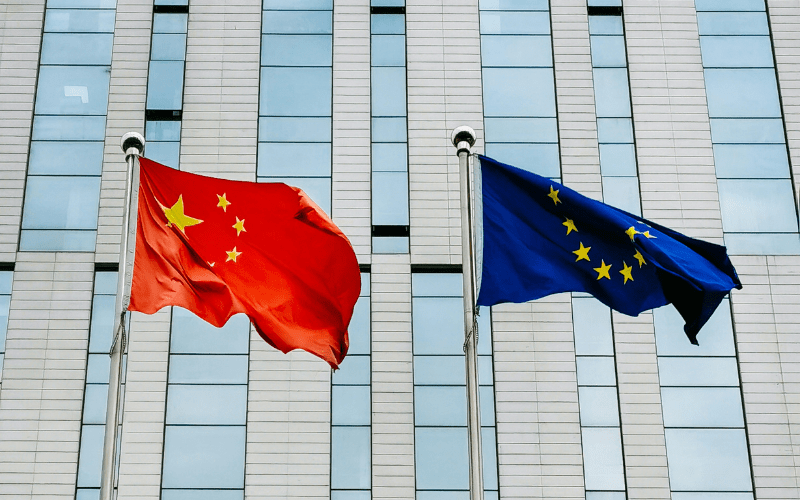
The first two months of Trump II have crushed European hopes that normal Transatlantic relations would resume after Donald Trump’s first presidency. The new Transatlantic rift has stirred up a blizzard of speculation about Sino-European rapprochement.
As Trump steers American foreign policy back towards 1930s dog-eat-dog great power competition, Europe and China face a choice between this multipolar great-power world and law-based multilateralism. Because these options have radically different meanings in Beijing and Brussels, their choices will affect the nature of both polities as well as China-EU relations and global governance.
Brussels contrasts European integration to a violent multipolar past. It hopes that Washington will eventually rejoin the liberal rule-based order, alongside other remnants of the Global West. China’s rulers have long striven to replace American unipolar hegemony with multipolarity, sometimes using multilateral institutions and international law as mere instruments.
EU-China disputes
Rapprochement would abruptly reverse a long-term deterioration of Sino-European relations. Beijing’s regular declarations of ‘strong commitment’ to Russia, backed by material support for Putin’s invasion of Ukraine particularly anger Europeans.
The EU has also complained for decades about China’s market-distorting practices. Its 2024 tariffs on Chinese electric vehicles (EVs) reflect worries about an existential Chinese threat to the survival of Europe’s manufacturing base.
It has meanwhile become ever harder to pretend that economic engagement with China under Xi Jinping’s repressive rule will encourage political liberalisation. Europe therefore joined the Biden administration in opposing Xi’s apparent use of China’s inexorable economic rise to overthrow the liberal world order and Western global leadership. European Commission President Ursula von der Leyen, a noted China hawk, coined the term de-risking in 2023 for a progressive insulation of Europe’s politics and economy from Chinese influence.
Rapprochement?
Despite Trump’s unpredictability and apparent admiration for Putin, musings by his Secretary of State, Marco Rubio about ‘peeling’ Russia ‘off a relationship with the Chinese’ appear unrealistic. However even hints of this ‘Reverse-Nixon’ diplomatic revolution, on the scale of Nixon’s détente with Mao’s China, encourage Sino-European solidarity against their respective American and Russian adversaries.
Beijing is therefore accused of exploiting the Transatlantic rift to accelerate a year-long campaign to ‘repair its relationship’ with the EU. Chinese Foreign Minister Wang Yi met several European leaders this February, calling for deeper cooperation with ‘Europe’ and peace negotiations on Ukraine.
Prominent Chinese commentator Zhou Bo argues that China ‘does not need to sacrifice its relationship with Europe for Russia’. It could ‘support Ukraine’s participation’ in peace talks and ‘collective security guarantees from all major powers, including the EU’.
Zhou adds that ‘Thanks to Trump,’ the US should ‘resemble’ Europe’s ‘economic competitor and systemic rival more than China does’. China’s recent economic weakness also helps assuage worries about China as an economic and political threat. Even von der Leyen now hopes for mutually beneficial ‘solutions’ that might expand China-EU economic relations. Her Commission colleagues signal openness to deeper cooperation on trade, economics and climate change.
Recent EU ‘mixed messages’ encourage Chinese hopes for resolution of the EV dispute. EU trade chief Maros Sefcovic has discussed Chinese investors transferring EV and battery technology to European partners, reversing established patterns of technological borrowing.
Chinese officials now eagerly offer Europe collaboration ‘to safeguard the global multilateral trading system’. Brussels ignored an earlier Beijing charm offensive during Trump’s first tariff war, in 2018, and negotiated separately with Washington. However two Trump terms, plus Biden’s protectionist Inflation Reduction Act have undermined Europe’s commitment to the US.
If Trump even continues Biden’s cultivation of alliances and technological embargos against China, the EU will feel much less duty to cooperate. EU de-risking legislation, such as its 2024 Forced Labor Regulation already tended to be later, weaker and less explicitly targeted against China than American equivalents. The US confronts China militarily in the Western Pacific. Europe does not.
New European values?
Any rapprochement with Beijing will compromise Europe’s human rights principles. It is less certain whether it would convert China to multilateralism or Europe to multipolarity.
China’s pitch for partnership with Europe stresses their common commitment to global governance through international law and institutions, based on ‘shared values’ of ‘secular multiculturalism’ that Trump threatens. Wang condemned great power rivalry, ‘the strong bullying the weak’ and a return to ‘the law of the jungle’. China has reined in its own strident Wolf Warrior diplomacy as its economy has weakened.
However Chinese leaders see no incompatibility between urging Europeans to ‘uphold multilateralism’ while simultaneously developing strategic autonomy to become an ‘important pole’ in the ‘multipolar world of the future’. Zhou welcomes Trump’s unilateralism and Transatlantic tensions ‘as the best’ Sino-European adhesive. This references the core Chinese multipolar narrative about Europe since the 1990s, of a rising power which will naturally partner with China to resist American unipolar hegemony.
Dr. Richard McMahon, Lecturer in EU Politics
Zhaoxin Li, MSc candidate in Political Science, UCL
Note: The views expressed in this post are those of the author, and not of the UCL European Institute, nor of UCL.

 UCL EUROPE Blog
Leave a comment