In 2015, at the 21st UN Climate Conference (COP21), 195 member countries under the UN Framework Convention on Climate Change adopted a new legally binding international treaty on climate change. As stated in Article 2, the ultimate objective of the Paris Agreement is to hold “the increase in the global average temperature to well below 2°C above pre-industrial levels” and to pursue efforts “to limit the temperature increase to 1.5°C above pre-industrial levels”.
But where do we stand in 2025, ten years after the Paris Agreement was adopted? In the past decade, where have we made real progress, and where is more decisive action needed? And in an increasingly turbulent “post-Paris” world, what is the role and relevance of the Agreement itself?
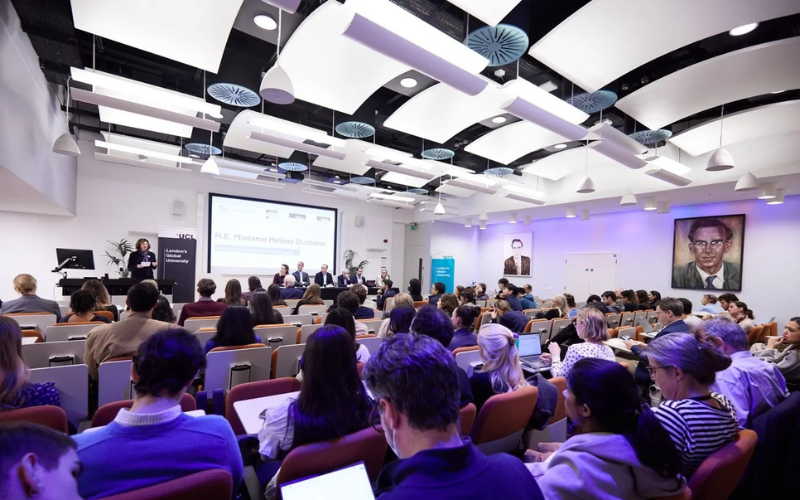
On 12th November 2025, UCL and the French Embassy in the UK brought together an expert panel of scientists, diplomats and industry representatives to explore these questions and take stock of the impact and role of the Paris Agreement a decade after its adoption. The high level panel included: Adam Berman (Director of Policy and Advocacy, Energy UK), Dan Bradley (Head of Climate and Environment at UK Mission to the EU), Jean Jouzel (Emeritus Research Director at CEA and member of the Academy of Sciences), Lisa Vanhala (Professor of Political Science and Pro-Vice Provost for UCL’s Grand Challenge of Climate Crisis) and Pedro Schilling de Carvalho (Assistant Professor of Financial and Environmental Law and Co-Director of the UCL Centre for Law and Environment). The panel and Q&A session was chaired by Eloise Scotford (Professor of Environmental Law, Co-Director of the Centre for Law and Environment and Dean of the UCL Faculty of Laws).
Her Excellency Madame Hélène Duchêne, French Ambassador to the United Kingdom set the scene, opening the event with introductory remarks. The Ambassador commended the timeliness of the event in light of another milestone anniversary — COP30 taking place in Belém, Brazil. Her Excellency offered several reflection points, all of which conveyed a clear message: there is hope.
Firstly, the Ambassador noted that the Paris Agreement is working. Before Paris, the world was heading to a 3 to 4°C warmer world. With the Paris Agreement and its system of Nationally Determined Contributions (NDCs), which countries are expected to update every five years, we are currently on track for 2.6°C (see latest Climate Action Tracker analysis for more details).
Her Excellency noted that there was still a long way to go to reach the 1.5°C target adopted in Paris. However, the numbers showed that we were able to avoid one of the worst case scenarios with the Paris Agreement in place.
The Ambassador also highlighted that it has never been less expensive to save the planet, for example, due to price drops in solar energy and significant advances in electrification. What would be key now is to deploy these climate-friendly technologies fast and at scale. Her Excellency noted the progress that France had already made and emphasised the importance of taking joint action, leaving the audience with another key message: If we act together, we can make it work.
Her Excellency encouraged a lively discussion, adding that there was no better place than UCL to discuss the role of the Paris Agreement. As science is increasingly under attack and misinformation is easily spread, discussions like these at universities are central to informing public conversations around climate governance and action.
Opening the panel discussion, chair Professor Scotford encouraged the panellists to reflect on the state of international policymaking and global climate governance in today’s turbulent geopolitical climate, as well as the impact of the Paris Agreement. She also challenged the panellists to share their outlook on the future of the Agreement and global climate governance, considering in particular potential barriers but also opportunities to take action in the near term.
How did the panellists feel about the state of international policymaking and global climate governance in today’s turbulent geopolitical climate?
The panellists agreed that international climate governance is struggling amid geopolitical turbulence, climatic and economic stressors. But they also highlighted reasons for remaining optimistic.
Kicking off the panel, Dan Bradley reflected on how multilateralism is under pressure, not only from a political but also from an economic perspective. Highlighting how the UK is directing significant efforts towards keeping multilateralism alive, he suggested that now was the time to move beyond just showing ambition to acting on and realising these ambitions. Providing insights into the process, he noted that there are still a lot of vested interests leading to inertia in the system. However, Bradley explained that while most progress may feel glacial from the outside, within the multilateral context, the same progress feels like it is happening at the speed of light. He also suggested that cooperation challenges, including the renewed withdrawal of the US from the Paris Agreement, tend to bring a sense of camaraderie and collaboration to the negotiation table. Jean Jouzel was less optimistic in this context, noting that every country should be involved in the process. Ten years after Paris, he missed a sense of solidarity between countries at the international level.
Lisa Vanhala noted that we are now at a pivotal geopolitical moment, not least in light of another monumental anniversary this year with the 80th anniversary of the United Nations. While this milestone is a reason to celebrate, it is also a time to reflect. As the UN is grappling with a liquidity crisis and reform efforts are underway, alternative modes of international collaboration are explored, including a move toward minilateralism and climate clubs. As Vanhala explained in a recent Conversation piece, such clubs offer smaller forums for like-minded stakeholders, including governments and intergovernmental organisations, the private sector and civil society, to come together and work on specific governance challenges and policy solutions. One example includes ‘phase-out clubs’ working, for instance, toward the phase out of harmful short-lived climate pollutants. At the same time, increasing geopolitical turbulence is caused by extreme events, such as the recent Typhoons in the Philippines or Hurricane Melissa in the Caribbean, which increasingly shape how countries approach negotiations.
From an economic perspective, as Adam Berman explained, climate action is often considered a selfless act with limited co-benefits. However, as the price of climate-friendly technology, such as solar, has been dropping dramatically, there is a lot of economic potential with improved economies of scale. Berman also suggested that it was because of the Paris Agreement that the market is broadly pushing in the right direction. This is because the agreement provides the needed long-term certainty to investors and the industry, putting in place a clear goal and framework beyond domestic political cycles.
What did the experts think about the Paris Agreement and its impact a decade on?
Ten years after the adoption of the Paris Agreement, the experts agreed on its pivotal role in shaping global momentum. However, key challenges remained around realising its key objectives, closing ambition and implementation gaps as well as addressing shallow progress in critical governance areas, such as climate change loss and damage.
As Jean Jouzel noted, the Paris Agreement has been created to secure a liveable world for current and future generations. Today, he observed that many country pledges are not in line with the agreement’s key objective of limiting global warming to 1.5°C above pre-industrial levels. In this context, he emphasised the role of country-level NDC reviews and the Global Stocktake to keep us on track and raise ambition toward this objective.
Lisa Vanhala introduced the concept of loss and damage to the discussion, referring to the adverse impacts of climate change beyond what we are able to adapt to. This includes slow- and sudden-onset events and the economic and non-economic losses they bring about. The Paris Agreement saw the inclusion of a standalone article on loss and damage, which helped institutionalise the issue at global level to date. However, Vanhala suggested that much of this institutional progress was performative. Many of these institutions were thinner in mandate and output than what was needed to address loss and damage effectively across scales of governance.
While Pedro Schilling de Carvalho noted that a treaty alone will not solve climate change, he highlighted the Paris Agreement’s positive impacts over the past years. In particular, for the financial and economic sectors, the agreement has provided agenda-setting, and normalising discussions around how public and private sectors can drive action and become more resilient. He also highlighted the challenging context in which the Paris Agreement has had to operate, including a lack of public finance.
Suggesting that we generally don’t talk enough about success stories, Dan Bradley emphasised that the Paris Agreement has been a forcing mechanism driving individual and collective action across scales of governance around the world. He explained that we would not be where we are today without the treaty in place. However, Bradley also made clear that we need to move much further and faster. Noting that he saw a lot of anxiety, especially in young people, he suggested that the best antidote to anxiety was action.
Looking ahead, where did the panel see potential barriers but also opportunities to take action in the nearer term?
Considering various barriers and opportunities for scaling up action and implementation, the panel agreed that significantly more work was needed at all fronts to keep the Paris Agreement with its 1.5°C goal alive.
In the context of climate change adaptation, Lisa Vanhala highlighted the need for better integrated policy action across sectors and scales of governance. Part of this work also concerned accelerating efforts on climate finance, not only at the global but also at the national level, as Pedro Schilling de Carvalho explained. He talked about the new Tropical Forests Forever Facility (TFFF) launched at COP30 as an innovative climate finance mechanism and promising south-south collaboration that can be leveraged in the future. Framed as an investment opportunity expected to create returns, it is particularly attractive for developing countries as both investors and beneficiaries of the facility.
The need for accelerated investments in climate finance was echoed by Dan Bradley. Connected to this, he saw a key issue that needed urgent attention in the way we communicate climate change and action. Bradley emphasised the need to bring back a narrative that can effectively sell the co-benefits of climate action to a range of stakeholders and sectors, highlighting how securing a safe and sustainable climate will also improve human health and wellbeing, security and provide economic opportunities.
The event ended with a lively Q&A discussion with audience questions ranging from sustainable future growth to the relevance of green bonds to responsible investments in climate leadership to the role of plant-based diets. On the question of whether we will be able to grow our way out of the climate crisis, panellists agreed that electrification efforts and a transition to clean power, as currently underway in the UK, were key to enabling sustainable and climate-friendly growth. Dan Bradley noted that a successful energy transition would make other transitions easier, including the transition to green agriculture. Regarding the role and promotion of plant-based diets, he added that it ultimately came down to communication and finding the right narratives to raise awareness and change established framings around cultural issues, such as food and lifestyle.
Jean Jouzel closed the discussion by emphasising the need to keep pushing forward to ensure the Paris Agreement remains alive and meaningful. He reiterated that every fraction of a degree matters and reminded the audience that, while many opportunities lie ahead, so do significant challenges.
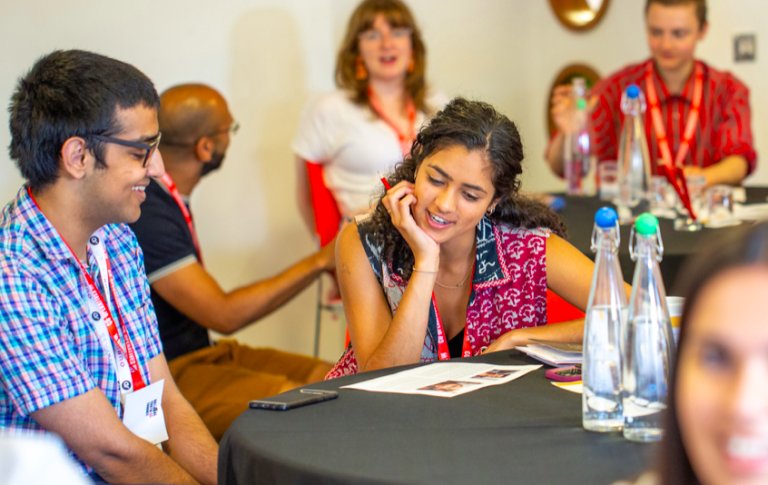
At a drinks reception, panellists and audience members had a chance to further exchange thoughts and ideas about the future of the Paris Agreement and the state of global climate governance in light of COP30.
Written by Dr. Friederike Hartz, Research/Policy Associate, UCL Grand Challenge of the Climate Crisis.
This article originally appeared on the Disruptive Voices blog on 26 November 2025.
Note: The views expressed in this post are those of the author, and not of the UCL European Institute, nor of UCL.
Photo: UCL Grand Challenges.
 UCL EUROPE Blog