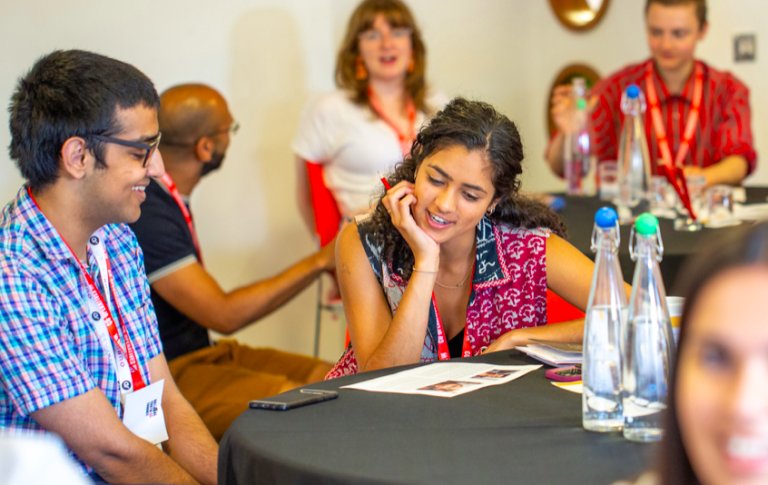
Elena Sofia Massacesi reflects on the first EU-UK Youth Gathering held at University College London, focusing on the three pillars of the EU’s Youth Strategy – Engage, Connect, and Empower.
In October 2023, University College London hosted the first EU-UK Youth Gathering. The gathering brought together young individuals from across the UK to facilitate meaningful policy dialogue about issues the youth face and understand how the European Union can continue to facilitate contact between young people on both sides of the Channel. The event was organised by the EU Delegation in the UK and the UCL European Institute with support from UCL’s European and International Social and Political Studies (EISPS) society, along with the European Economic and Social Committee, the European Parliament Liaison Office, and the British Council´s Stronger Together project.
Pedro Serrano, the EU Ambassador to the United Kingdom, opened the summit by highlighting the three pillars of the EU’s Youth Strategy: Engage, Connect and Empower. Over the next two days, conversations during the workshops, roundtables and breakout groups returned to those three pillars, demonstrating the importance of young people’s voices in cultivating the EU-UK relationship.
Engage
The EU’s strategy aims to promote active citizenship – encouraging young people to be a part of the decision-making process. In small group discussions, we started by asking ourselves how young people could become more engaged citizens, especially given that their participation is traditionally dwarfed by that of older age groups. A first concern was access to opportunities: students around the table reported that they often saw the same faces at policy oriented events. We agreed that this was not only for geographic reasons, but because young people are sceptical about the value of participating. Many young people are disillusioned with their government, so how can we be expected to be politically active? However, as the moderator noted, addressing challenges in a democracy requires participation. If young people do not participate, we cannot expect our interests to be fully recognised and represented.
However, for young people to participate, institutions must create environments where young people feel that their time will yield an outcome; they must overcome adultism. The EESC highlighted its appreciation of the youth representatives attending their meetings and provided examples of EU-led initiatives which aimed to improve young peoples’ engagement in politics, such as the “Your Europe, Your Say” project. An attendee further highlighted the direct power of voting by referencing the Polish parliamentary election, where the high turnout of young voters and female voters was decisive in the fall of the ruling PiS party. 68.8% of Poles aged under 29 voted – over a 22 percentage point increase from its last election – and young voter turnout was greater than for voters over 60 years old.
Connect
Cultivating cross-border connections is integral to the values and objectives of the EU. Reasserting shared values between the EU and the UK was a recurrent theme throughout the conference: often the conversations emphasised looking beyond politics to unite the EU-UK youth. In a discussion with participants from the South and East of the UK, several students from European student societies voiced their struggles to involve British students in their activities, as well as resistance from their university in establishing their society. They lamented the misconception that European societies were inherently political, and that the post-Brexit UK had no place in Europe. Leaders of the University of Bath’s European Society explained that they challenged that narrative by focusing on cultural and social events, and another group discussed having organised an Erasmus-supported mixed media event, drawing in a very diverse audience. Other societies described organising joint socials with sports or arts societies.
All the examples shared sought to foster intercultural engagement in an apolitical space, where the enjoyment of the event itself could demonstrate the value of multiculturalism.
Empower
When asked to list some of the most important problems facing young people today, the small group discussion I was a part of listed access to the job market as one of their most pressing concerns. The EU’s pillar of empowerment aims to enable young people by providing training and learning opportunities outside of school settings. Attendees at the summit voiced their concerns on finding employment abroad due to new visa requirements under the Brexit rules, as well as the difficulties in finding paid internships and developing professional skills whilst in university.
Youth representatives from various business sectors also demonstrated the need for government support to current employees. A young business owner stressed the need to help small businesses survive the increased compliance costs post-Brexit, while a young farmer described the uncertainties around exports, loans, and the increase in administrative rules under the new British framework for veterinary certification. Within the UK market, the threat of cheaper competition from the United States and Australia poses an especially high threat to Welsh farmers, which were previously protected under the EU’s single market.
Conclusion
As UCL’s provost noted, collaboration and the exchange of ideas is also central to the academic mission, and UCL is committed to maintaining and strengthening its connections to the continent. The summit allowed young participants to focus on shared challenges and discuss how to nurture a new generation of engaged citizens. Despite uncertainty ahead, participants made it clear that the UK and EU can still benefit from collaboration, building on our shared values.
Elena Sofia Massacesi is a third-year undergraduate student in Politics and International Relations (PIR) at UCL. She is a Student Ambassador with the UCL European Institute.
Note: The views expressed in this post are those of the author, and not of the UCL European Institute, nor of UCL.
 UCL EUROPE Blog
Leave a comment