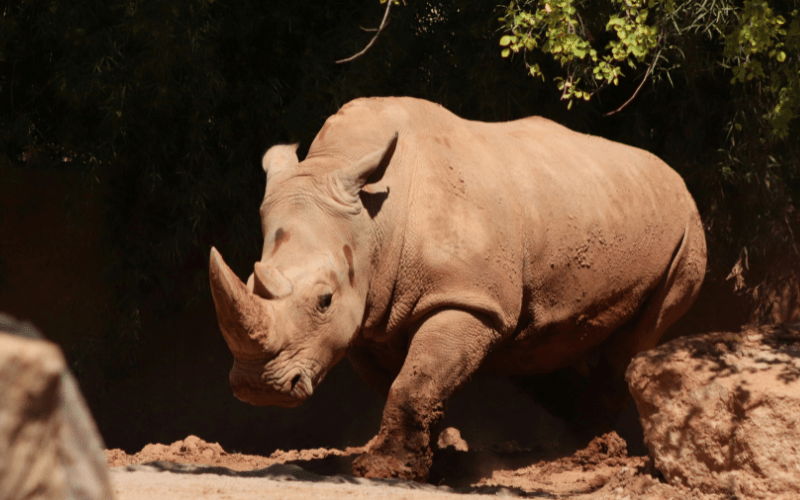
“Rhinoceros” is a play published in 1959 by French Romanian playwright Eugène Ionesco (1909-1994). I have just seen an excellent adaptation of this work at London’s Almeida Theatre, which provides food for thought for this article. This play in three acts and four tableaux is disturbingly topical: it describes an epidemic of “rhinoceritis”. This affects the inhabitants of a small provincial town, who turn into rhinoceroses. The story is a tragicomic parable of the unstoppable rise of fascism in Europe on the eve of the Second World War.
Ionesco highlights the psychological factors that favour the victory of totalitarianism over democratic values and principles. He breaks with functional interpretations of fascism, whether materialist or Marxist. According to these, fascism emanates from the capitalist bourgeoisie, anxious to preserve its hold on political power in the face of the imminent threat of proletarian revolution. Fascism may not be directly created by “authoritarian liberals”, but it can count on their financial and intellectual support. In return, the fascist regime will defend the class interests of the capitalists.
A reflection on social conformism
This analysis is relevant to a certain extent, but it is nonetheless insufficient. It overlooks the mass movements that gave fascism a popular base. Both Mussolini’s fascism and Hitler’s Nazism were based on movements that brought together sections of the middle and working classes.
To understand the rise of fascism, we need to consider the psychological and subjective factors that relate to the culture and political context of the moment: emotions, fears, hopes, inertia, conformism and the political opportunity structure. A Marxist vulgate tends to deny the people any agency in the construction of a political phenomenon such as fascism.
“Rhinoceros” places fascism at the heart of the social practices and representations of an era. Ionesco shows that we are all potential rhinoceroses, and that we must first become aware of this, to bring down the “foul beast”. This parable of totalitarianism is also a reflection on social conformity. We think that we are critical, rational social agents, but the border with our irrational, gregarious selves is porous. In situations of political crisis, this boundary can disappear in a matter of days, or even hours. Ionesco invites us to reflect introspectively on our inner rhinoceros.
In “Rhinoceros”, Jean and Bérenger are two friends with dissimilar characters. The first, intellectual and peremptory, is not stingy with his paternalistic advice to the second, a reserved, rough-looking man. In this rational world, no one wants to believe that one or two rhinoceroses have burst into the village in plain sight. Only the timid Béranger makes such a hypothesis and is disdainfully put in his place by Jean. When Jean finally admits that a rhinoceros has entered the village, the conversation loses itself in futile considerations: are they rhinoceroses with one or two horns?
The disbelieving population must soon face the facts: the village has been invaded by a horde of rhinoceroses which are wreaking havoc. If denying the danger is no longer an option, how should they behave? How do you resist the “rhinoceritis” virus that turns humans into animals? In a legal publishing house, the debate is raging: Mr. Papillon, the boss, is more concerned about his company’s profits than his employees’ safety. It is a right-wing man who dismisses Mr. Boeuf, one of his employees, when he transforms into a rhinoceros.
Botard, another employee, is a former schoolteacher. A union representative, he is a non-conformist and remains sceptical. He believes it is a capitalist plot, and an “infamous machination” created out of thin air by the media.
Dudard is an intellectual who uses syllogisms to justify the unjustifiable. Ionesco confided that Jean-Paul Sartre inspired the character of Dudard, because Sartre always found some excuse for Stalin’s crimes. Dudard’s sophist reasoning normalises the brutal intrusion of the rhinoceroses. Ionesco portrays Botard as a Communist apparatchik and Dudard as a left-wing intellectual. Both invoke high principles in the name of the people but are no more resistant to “rhinoceritis” than the capitalist Mr. Papillon. Peremptory Jean self-complacently relativises his rallying to the enemy: “After all, rhinos are creatures like us, with the same right to life as we have!”
They all metamorphose into rhinos. Sweet, cheerful Daisy turns a deaf ear to Berenger’s amorous advances and joins the rhinoceros pack, admiring their beauty, ardour and energy. So, it is up to Bérenger, an anonymous character scorned by all, to rebel alone against “rhinoceritis”. He hesitates, doubts, but finally decides not to capitulate: “I’m the last man standing, and I’ll stay that way to the end! I will not surrender!”
Circumstances and hazards of fascism
Bérenger’s act of resistance is remarkable. On the one hand, he is the only one to lead this struggle against the bestiality of fascism, while his fellow citizens succumb to it out of conformism or because they are fascinated by the brutal vitality of totalitarianism. On the other hand, he is the only one to reject the conformism of those around him. First and foremost, it is a cultural conformism: the people around Bérenger speak a wooden language full of clichés. Their reasoning changes abruptly when circumstances seem to dictate it. As he transforms into a rhinoceros, Jean exclaims, “Humanism is dead, and those who still claim to be humanists are sentimental old men.” Bewildered, Beranger asks, “Are you suggesting that we replace our moral laws with the law of the jungle?”
“Rhinoceros” gives us a better grasp of how totalitarianism is born and strengthened: it feeds on our hesitations, our superficial morality, our cowardice and, above all, our gregarious atavism. The rise of fascism is not so much the fruit of capitalist cunning as the consequence of conjunctural circumstances and political vagaries. Donald Trump’s first term was not fascist, and his second is still not. But it could become so.
Trump is bluffing and intimidating while clearly trying to break free from the rule of law. He is paying close attention to the reactions of judges, his political opponents, the financial markets, his international allies and enemies. If his illiberal power grabs do not meet with major resistance, he will continue to undermine the rules of democratic operation, and the American fascist moment will come.
In France, the Rassemblement National does not have the characteristics of a fascist party. It is a far-right, nativist and reactionary movement. But once in power, won’t it become one? Here too, it would be a question of circumstances and hazards: would the traditional right-wing parties govern with the RN or oppose the new power? Would they maintain their course to the right, while more closely mimicking the RN’s policies? Would the left once again become a genuine force for emancipation, or would it continue to scare voters away with the authoritarian populist pole of La France Insoumise and the wishy-washy social democracy of the Parti Socialiste? Would left-wing media intellectuals pontificate at length against “French Nazism” or propose rigorous analyses to understand the mainspring of popular support for the RN?
Would “confusionism” further accentuate the blurring of ideological markers between left and right? Would the media honestly inform the public, or would they be a sounding board for the RN? Would judges render justice or interpret the law to the benefit of the extreme right? Finally, how would voters and citizens react: with resignation, apathy and conformism like most of the protagonists in “Rhinoceros”? Or, like Bérenger, as ordinary resistance fighters determined to defend their threatened freedoms?
Dr. Philippe Marlière, Professor of French and European Politics, UCL
Note: The views expressed in this post are those of the author, and not of the UCL European Institute, nor of UCL.
Featured Image: Photo by Dill Douglas on Unsplash



 UCL EUROPE Blog
Leave a comment