Markus Patberg
Two themes were central to Habermas’s later contributions to political theory: democracy in the European Union and the digital structural transformation of the public sphere. In both areas, he explored how the preconditions for democratic opinion and will formation could be developed and preserved in the context of adverse circumstances.
Given the political constellation the EU faces today – marked by the US government’s more or less open hostility toward liberal democracy in Europe and the rise of a tech oligarchy with global reach – it is essential to bring together the two strands of Habermas’s work. Taking this approach points the EU in a clear direction: it must reinvent itself as an order for the defence of democracy.
European Democracy: The Pouvoir Constituant Mixte
The theoretical foundation of Habermas’s work on the EU always was his “system of rights” and the related model of deliberative democracy. The system of rights describes the constitutive conditions of constitutional democracy. According to Habermas, without a constitution that guarantees for all citizens equal freedoms, membership, the enforceability of rights, and equal participation in opinion and will formation, there is no democracy. In this way, the system of rights also provides a measure of democratic regression.
For Habermas, the puzzle of European integration was how to establish much-needed democratic capacities at the EU level without undermining the normative content of the member state constitutions. His solution for the transnationalization of popular sovereignty – and his most important contribution to EU democratic theory – was the idea of the “pouvoir constituant mixte”. European democracy, Habermas argued, is based on a dual demos, composed of citizens in two roles: as members of national demoi and of a European demos.
With this model, Habermas gave the classical idea of constituent power a specific meaning tailored to the EU context. In doing so, he deliberately built in a safeguard: the democratic constitutions of the member states must not be allowed to be subsumed into a pan-European order. According to this often criticized view, the demoi of the member states participate in European integration only on the condition that their national constitutions are preserved as guarantors of the achieved level of democracy and the rule of law.
Digitalization: The Constitutional Imperative to Protect the Public Sphere
Regarding the digital structural transformation of the public sphere, Habermas focused less on the institutional-legal dimension of democratic politics than on the infrastructure of informal discourse, particularly changes in the media system.
His diagnosis was that the platformization of the public sphere leads to the emergence of semi-public spheres – so-called echo chambers – into which many citizens retreat. This development, he argued, is further fueled by the economic logic of the platforms. For social media operators, it is rational to turn political communication into a commodity of an attention economy. In doing so, they are in no way obligated to assume the editorial function of traditional media outlets or to subject online content to quality control. Authoritarian actors intent on wrecking the public sphere have been exploiting this constellation for years.
Even though Habermas did not offer any specific recommendations, he left no doubt that it is “a constitutional imperative” to maintain “a media structure that ensures the inclusiveness of the public sphere and the deliberative character of public opinion and will formation”. The digital realm must be shaped in line with the system of rights.
The EU as an Order for the Defence of Democracy
Since Habermas’s contributions, the political situation has changed fundamentaly. Given the path the US has taken during Trump’s second term, the EU member states are increasingly on their own in their commitment to democracy. At the same time, control over social media – and, in parallel, over the rapid development of artificial intelligence – is increasingly being exercised by tech oligarchs who have aligned themselves politically with Trump and are reshaping the digital public sphere in an authoritarian manner.
EU democracy and the digital public sphere can therefore no longer be treated as separate issues. If any institution possesses the necessary power to effectively regulate Big Tech and to fulfill Habermas’s “constitutional imperative” of preserving a democratic public sphere, it is the EU.
In a sense, this broadens the remit of the pouvoir constituant mixte. For Habermas, the task of the national pillar was to protect the member state constitutions from being undermined by inappropriate transfers of authority to the EU. In light of democratic regression within EU member states, the question has long arisen whether the EU should in turn take measures to restore democracy in the member states. Today, it is becoming clear that another key role of the European pillar must be to extend a protective shield over the constitutions of the member states to safeguard them against external forces undermining democracy.
Such a redefinition of the EU’s purpose – as an order for the defense of democracy – would also offer opportunities for revitalizing the project of supranational democracy. Both US tech companies and the US government have strongly resisted EU measures – the Digital Services Act, the Digital Markets Act, and the AI Act – going so far as to impose sanctions on EU officials and threaten the Union with tariffs. It has not gone unnoticed among citizens that this aggressive response reflects the EU’s power in this area. For the EU, the conflict thus offers a chance to prove its (dormant) democratic value. There are indications that the EU can count on the support of European citizens here – provided it stays the course and focuses on democracy as guiding principle of digital regulation rather than “competitiveness” and “innovation”.
Unfortunately, recent developments rather suggest that the EU might be giving in to Big Tech. Moreover, any effort to defend democracy at EU level faces the problem that the influence of right-wing authoritarian actors is growing also within EU institutions – particularly in the European Parliament. Nevertheless, the defense of a democratic public sphere in Habermas’s sense is today one of the European Union’s foremost tasks.
Markus Patberg is Professor of Political Theory and History of Ideas at Universität Greifswald, Germany.
Note: The views expressed in this post are those of the author, and not of the UCL European Institute, nor of UCL.
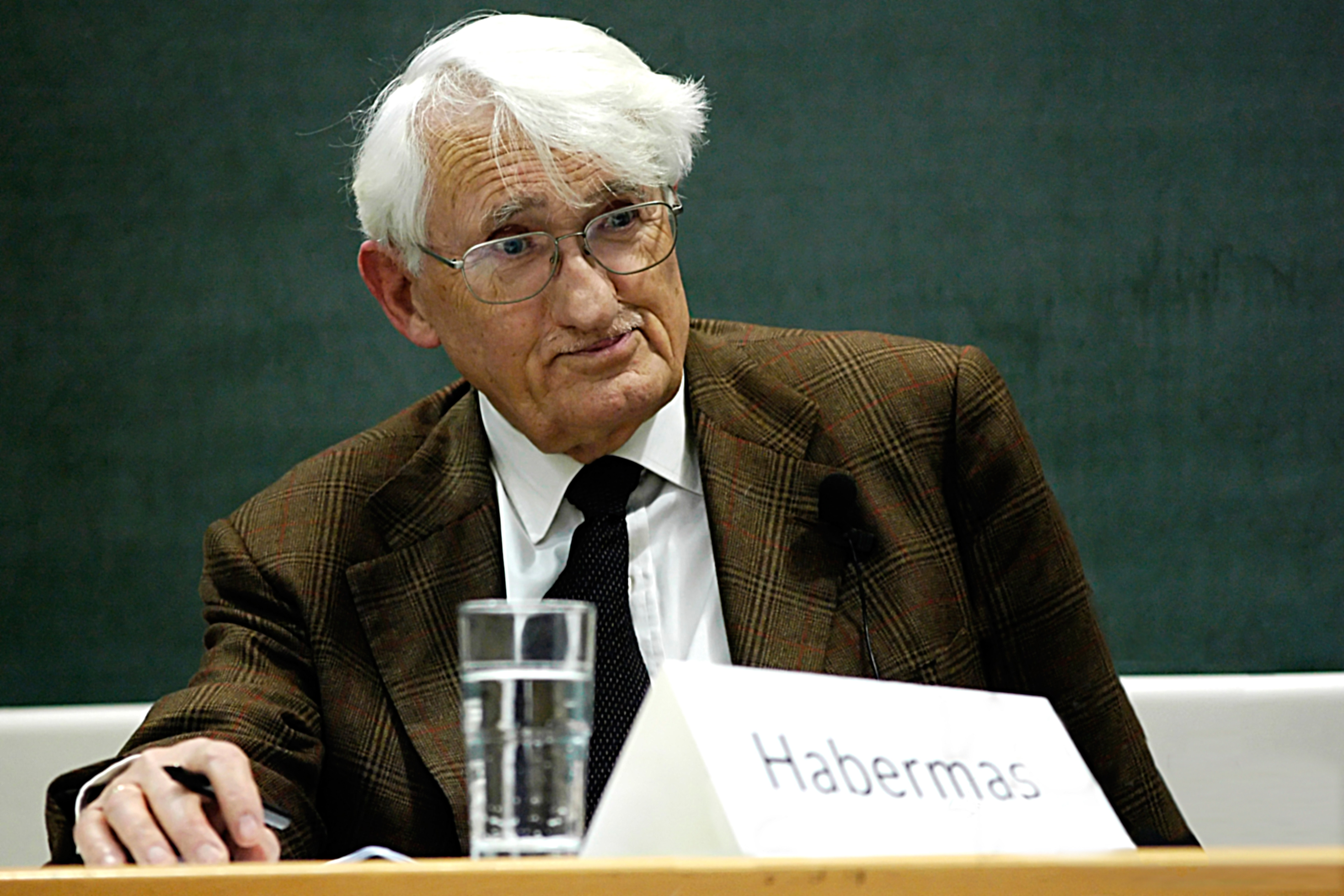
Image: Jürgen Habermas during a discussion at the Munich School of Philosophy on 27 July 2008, by Wolfram Huke via CC BY-SA 3.0, via Wikimedia Commons.





Leave a Reply