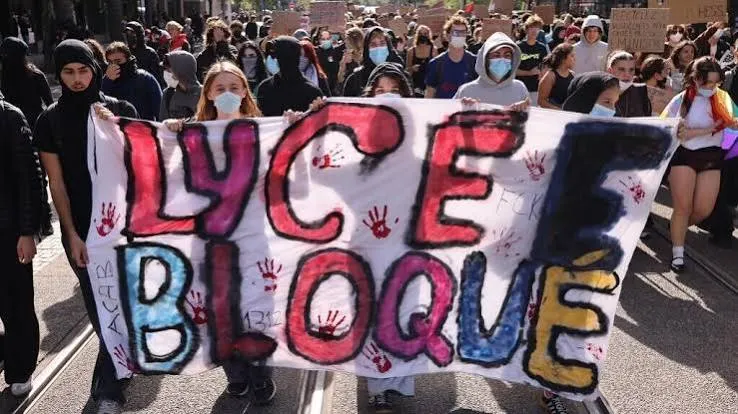
As student protests and wider social movements challenge the political establishment, Philippe Marlière, Professor of French and European Politics at UCL, reflects on the origins and implications of growing unrest in France.
Six months before the first round of its presidential elections, France is experiencing a dramatic wave of social movements against a backdrop of intense political and social tension. The cycle began on September 17 when teachers at a secondary school in Créteil, near Paris, went on strike to protest staff shortages. Two days later, pupils decided to blockade their school in solidarity. This local action sparked a nationwide protest movement. School occupations quickly spread to other secondary schools in the Paris region and then throughout the country. University students subsequently joined the movement. Conditions vary from one school to another, but the same demands are heard everywhere: Pupils complain about overloaded timetables and having to study in buildings that are sometimes unfit for use; they demand that absent teachers be replaced; and they are calling for the abolition of Parcoursup, the university pre-registration platform criticized for its opaque decision-making process.
The current student mobilization is unprecedented in several respects. It is largely independent of political parties and trade unions. Most of the demonstrators are minors and first-time protesters. Usually, universities are the first to protest, followed by inner-city secondary schools attended by children from politicized bourgeois families, but this movement began in secondary schools in working-class suburbs with large populations of children from ethnic minorities.
On October 17 and 24, 800,000 demonstrators took to the streets in towns and cities across the country. The central rallying cry was against the high cost of living, but the call to action sought to bring together struggles and social groups of different kinds, including secondary-school pupils and university students, often accompanied by their parents, as well as employees from a range of professions. Leaders of the Yellow Vest movement, active between 2018 and 2020, also called on people to join the demonstrations.
French society is on the verge of igniting. The principal architect of this fiasco is President Emmanuel Macron, who is bringing his second and final term to an end in a lamentable state. His elite-driven policies and right-wing drift have brought French society and politics to a parlous state, with no clear way out.
In the spring of 2017, Macron was elected president at age thirty-nine. He broke with the established pattern of presidential winners, who were normally mature politicians elected on their second or third attempt, identified with either the left or the right, and supported by a political party and a network of elected representatives. Macron stood alone and had virtually no political experience. After a spell in the financial sector, he had served as an adviser to François Hollande at the Élysée Palace before becoming, briefly, minister of the economy in a Socialist government from 2014 to 2016.
Though coming from a social-democratic background, Macron upended the political landscape with his mantra “en même temps” (“at the same time”). This posture proclaimed a refusal to choose between left and right, claiming instead to reconcile them by extracting what was “best” from each. Macron outlined a project that would reconcile order and economic freedom with civil liberties and social justice. Some welcomed the destruction of the left–right divide as a sign of “modernity.” Macron received support from the left, including social democrats in the Parti Socialiste, and from the right, including the Christian democratic center-right and conservatives in Les Républicains.
Macron’s en même temps has proved to be one of the greatest deceptions in French political history: He appointed officials from both the left and the right, but he governed from the right from the outset, moving further right over the course of his two five-year terms. In doing so, he destroyed the Parti Socialiste and Les Républicains, the two mainstream political forces of the left and right. He also alienated an increasing number of voters, who gradually turned toward either the far right (Marine Le Pen’s Rassemblement National) or the populist radical left (Jean-Luc Mélenchon’s La France Insoumise).
The Yellow Vest movement in 2018 was the first warning shot fired by working- and middle-class people struggling under the burden of rising prices for essential goods, particularly fuel. Poverty has increased markedly under Macron’s presidency. It is estimated that nearly 16 percent of the total population, or around 10 million people, now live below the poverty line. Conversely, the wealth of France’s richest individuals has grown spectacularly. Between 2017 and 2026, the combined wealth of billionaires more than doubled, increasing by over €220 billion. France has fifty-three individual billionaires, whose combined wealth exceeds that of nearly half of the French population. The Solidarity Tax on Wealth was abolished in 2018, and the introduction of a 30 percent flat tax on dividends and financial capital gains. Taken together, these tax cuts on capital represent a loss of €50-60 billion a year in public revenue.
While Macron’s neoliberal policies came as no surprise, his growing authoritarianism was by no means obvious in 2017. On the contrary, he presented himself at the time as a political liberal, committed to protecting civil liberties, and as an anti-racist president who championed a French form of multiculturalism. His illiberal turn has fueled polarization, generating social and racial tensions that helped normalize Le Pen’s Islamophobic rhetoric. Widening inequalities, low wages, the deterioration of once high-performing public services (a source of national pride), the spread of racist discourse in media outlets controlled by far-right oligarchs, and the collapse of a divided left have all contributed to the explosive situation we see today.
This account of Macronism helps explain the radicalization of a part of the population, especially young people, who have long been neglected by public policy in France. Gen Z is indeed being mistreated. Educational conditions are deteriorating: The university system is underfunded and unworthy of a wealthy country. The labor market is in dire straits. Wages are low. Public services are in decline. And young people from educated middle-class backgrounds face the prospect of enjoying a lower standard of living than their parents or grandparents.
The demonstrations on October 17 revealed the diversity of young people in France. There are those from inner-city areas, who are predominantly bourgeois and perform well academically but fear moving downward socially, and those from the suburbs. While some young people in working-class neighborhoods succeed in their studies, others fail in unsuitable educational programs or courses that offer no employment prospects, leading then to develop a deep sense of social illegitimacy, exacerbated by the ostracism to which they are subjected. Right-wing politicians and media outlets publicly describe them as racailles (roughly equivalent to “scum”), a highly derogatory term with racist overtones. It is the constant, humiliating experience of police violence and racial profiling that unites young people across the suburbs.
The protests have also been marked by scenes of looting, damage to public buildings, and police violence. These acts of violence have structural causes, intensified by failure in two areas that are highly valued in our materialistic societies: education and money. The looting that has accompanied the protests provides an opportunity to take revenge for the humiliations of everyday life. Nevertheless, it expresses no coherent political project (those with explicitly political aims surrounding looting are in the minority). On October 17, looters destroyed not only luxury shops but also small businesses owned by Arab and Asian minorities.
Since his first election, Macron has been completely deaf to social demands, particularly those coming from young people. His refusal to consult, negotiate, compromise, or withdraw unpopular proposals, like a pension reform plan in 2023, is unprecedented in France. In their day, Charles de Gaulle, François Mitterrand, and Jacques Chirac paid attention to popular anger and shelved measures that provoked opposition from most of the population. The highly authoritarian management of social relations has been the defining characteristic of Macronism.
The government’s sidelining of trade unions has also contributed to the radicalization of citizens. Historically, unions and left-wing parties have helped integrate the working class into the political system. They are now too weak to influence the course of events, and an angry population is taking matters directly into their own hands. People know that determined social movements can sometimes win victories. In May 1968, trade unions secured a historic 35 percent increase in the minimum wage. In 2018, the Yellow Vests forced Macron to provide an exceptional €17 billion in funding to help people cope with the high cost of living.
The American left often sees France as the epicenter of radicalism, with triumphant left-wing parties, influential trade unions, and prominent Marxist intellectuals. Yet despite the roiling social conditions in the country, the French left has never been as disoriented and weak as it is today. In the run-up to the 2027 presidential election, the French left has failed to resolve the strategic, ideological and personal conflicts that undermined both NUPES (2022) and the New Popular Front (2024), two broad electoral alliances that ultimately proved short-lived. The main left-wing parties have been unable to agree on a primary to select a single presidential candidate. The left remains politically fragmented and electorally weak, attracting between 30 and 35 percent of the vote in aggregate, and is divided over policy, particularly foreign affairs. Moreover, it lacks an undisputed leader capable of appealing to broad sections of the electorate, as François Mitterrand did in the 1980s.
Mélenchon, who is standing for president for the fourth consecutive time, creates an illusion of strength. He does know how to speak to young people and echo some of their demands, and he has also been willing to raise the issue of anti-Muslim racism and police violence. However, Le Pen is well ahead among all age groups other than the young, and across all socio-professional categories, including manual workers and retirees. Opinion polls show that if Mélenchon were to qualify for the second round, he would likely be decisively defeated by Le Pen: Right-wing voters would overwhelmingly transfer their support to Le Pen, while a large proportion of the social-democratic electorate would abstain.
Radicalized social movements sometimes win victories in France, but these victories come at a physical cost. The police use dangerous weapons that can blind and even kill, including rubber-bullet launchers, stun grenades, tear gas, and electric stun guns. Over the past month, minors have been maimed by plastic bullets that have caused permanent disabilities. One demonstrator died in Paris in October following a police charge. Since the end of September, more than 8,000 demonstrators (85 percent of them minors) have been arrested by the police. Most have been imprisoned, and 35 percent face criminal proceedings.
Under Macron, protests have become dangerous sites of confrontation. Many citizens are now afraid to demonstrate, despite this being a constitutional right in France. Students’ placards use dark humor to denounce police violence: One reads, “La police nous prothèse” (“The police provide us with prosthetics”), a pun on “La police nous protège” (“The police protect us”), while another declares: “A bullet in the jaw, because the truth comes out of the mouths of children.”
Social anger is running high, and the convergence of workers around the issue of the cost of living could enable the left to place social justice and redistribution at the heart of the presidential campaign. However, questions of law and order and public safety seem likely to predominate, creating favorable conditions for the far right.
Furthermore, France’s fiscal situation is very poor. The public deficit stood at 5 percent of GDP in 2025, exceeding the 3 percent ceiling established by European rules. Public debt reached 120 percent of GDP this fall. With debt continuing to grow, annual interest payments are expected to reach €74 billion by the end of 2026. A proposal by the economist Gabriel Zucman to introduce a minimum tax of 2 percent on the wealth of the very richest individuals, could gain traction, but it is likely media framing will encourage a discourse centered on austerity.
The French are fighting on the streets for better public services, decent jobs, and higher wages, while opinion polls suggest that they increasingly embrace the values of cultural liberalism, including gender equality, anti-racism, and support for immigrants. Yet none of the left-wing parties seems to be benefiting from these trends. Paradoxically, France is also becoming an increasingly polarized and violent country, as illustrated by the racially motivated massacre in Trappes on October 23. The country could soon have a far-right head of state for the first time since the Vichy regime. In a sense, the Americanization of French society is well under way.
Philippe Marliere is Professor of French and European Politics at UCL.
This article first appeared in Dissent magazine on 30 October 2026: https://dissentmagazine.org/online_articles/french-protests-macron/ and is replicated with consent.
Note: The views expressed in this post are those of the authors, and not of the UCL European Institute, nor of UCL.




Leave a Reply