Pre-history of the European movement
Standard accounts of the European movement locate its origins in interwar Vienna. Count Richard von Coudenhove-Kalergi (1894–1972), widely regarded as the ‘ideological father of a modern, unified Europe’, published his seminal manifesto Pan-Europa in 1923, launching what subsequently became recognised as the Pan-European movement, a new force that went on to inspire Aristide Briand’s 1929 proposal for a European Federal Union to the League of Nations and later influenced the architects of post-1945 European integration. This chronology has characterised scholarly understanding of the European idea’s genealogy for much of the twentieth and twenty-first centuries.
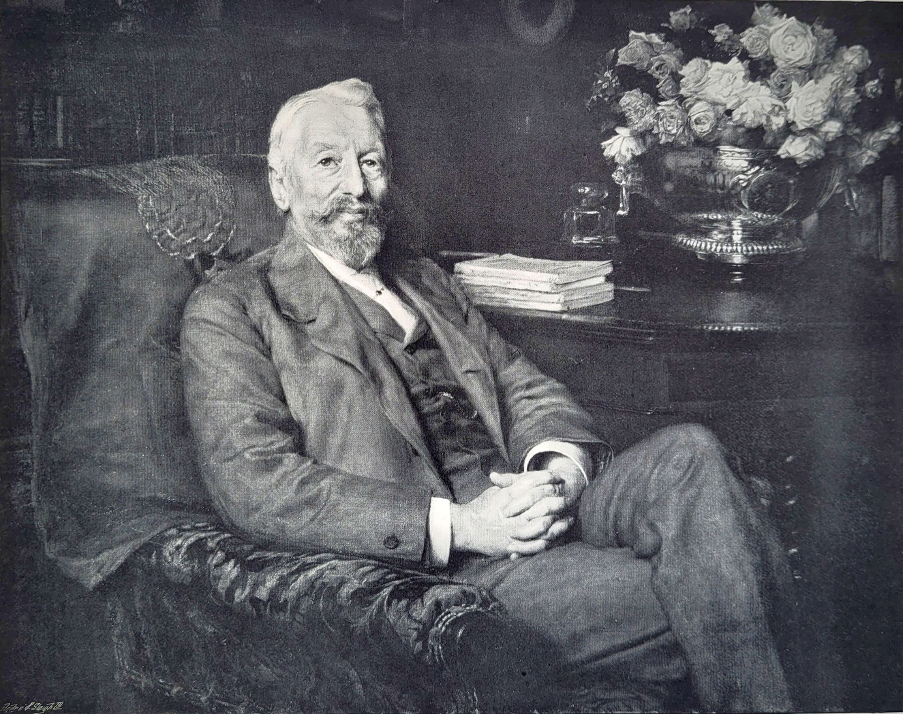
Archival evidence suggests this chronology requires revision. Preceding Coudenhove’s Pan-European Movement by two decades and a world war, the first organisation to mobilise mass support for a federation of the European states in the twentieth century emerged not on the Continent but in Britain, extending the established genealogy of the European movement in terms of both chronology and geography. Sir Max Waechter (1837–1924), a fabulously wealthy shipbroker and sole representative of the Nobel brothers’ Caspian oil business, in the last decade before 1914 led a sustained continent-wide campaign for European federation that commanded headlines, secured royal audiences and attracted thousands of members.
Waechter had immigrated from Prussia in 1859 and naturalised as a British citizen in 1865. Concerned by the deteriorating relations between his country of birth and his adopted homeland, he sent a memorandum to King Edward VII and the German Kaiser in 1906, proposing a federation of the European states as the only means able to avert a major war. Receiving cautiously positive responses from both monarchs, he spent the years from 1907–1913 touring the continent aboard his early-twentieth-century equivalent of a modern-day oligarch yacht, the S. Y. Rovenska, formerly owned by an Austrian archduke, securing audiences and discussing his plan with many sovereign heads of state. Inspired by the example of the United States of America, his proposal called for the pooling of foreign and defence policy in the hands of a permanent conference of the Great Powers, and free-trade arrangements across the continent. His attempts at personal diplomacy were regularly reported in the British and European press.

The Roman Congress and the European Unity League
Together with the like-minded Italian aristocrat and peace campaigner Orazio Zunica, Prince di Cassano (1855–1926), Waechter organised what the American historian Carl Pegg has called one of the first collective manifestations of the European idea: the Inaugural Congress of the European Federation in Rome. Held at the Collegio Romano over five days in May 1909, the convention assembled delegates from across Europe to examine proposals for political federation and legal harmonisation.
In 1913, Waechter institutionalised his scheme in the form of a membership organisation, the European Unity League, in London, with the intention of creating similar national chapters across Europe, as he wrote to Bertha von Suttner in early 1914. The organisation launched with full-page advertisements in two dozen national newspapers, including The Times and The Daily Mail, which even carried the European Unity League’s manifesto on its front page, notwithstanding the paper’s typically nationalist editorial line. In the fifteen months before the outbreak of war curtailed its activities, the League attracted no less than 20,000 members, including a tenth of both Houses of Parliament, a significant part of the armed forces leadership, and, in the person of James Ramsay MacDonald, a future Prime Minister.
The organisation’s cultural prominence is further evidenced by Max Pemberton’s 1912 novel War and the Woman (American title Swords Reluctant), a roman-à-clef in which Waechter appears in thinly veiled guise as Sir Jules Achon. Pemberton, previously known for adventure fiction, dedicated the work to Andrew Carnegie and acknowledged Waechter’s cooperation. One of the most popular authors at the time, a friend and associate of Arthur Conan Doyle’s, he cleverly used the tropes of the then popular genre of invasion literature for a pacifist novel that supported the aims of the European Unity League. Experiencing a second edition in 1914 and being serialised in several British and Dominion newspapers, it is also indicative of the reach of Waechter’s organisation in pre-1914 Britain.


A British Intellectual Tradition
The European Unity League had distinctly British roots. It emerged from what the political scientist Michael Burgess has termed the ‘triad of British federalist thought’: federal solutions for Ireland (‘home rule’), imperial federation and European federation, three interwoven strands of the same intellectual current. Before turning to Europe, Waechter had served as vice-president of the British Empire League, a successor to the Imperial Federation League, and Joseph Chamberlain’s Tariff Reform League, both organisations that sought to transform the Empire along federal lines to preserve it in perpetuity. His European scheme transposed the institutional framework of imperial federation to the continental context.
Europeanism was thus conceived through distinctly British political categories, an intellectual lineage that can be traced back to, inter alia, William Penn’s proposal for a ‘European Dyet’ (1693), Jeremy Bentham’s plan for universal peace (1789), John Robert Seeley’s call for a ‘United States of Europe’ (1871) and W. T. Stead’s advocacy on the occasion of the first Hague Peace conference (1899).

Historical Significance
The archival recovery of Waechter’s campaign matters for three reasons. First, it shows that serious proposals for European federation were being advanced almost a generation before the interwar period, requiring us to rethink when the European movement actually began. Second, it complicates prevailing narratives of British exceptionalism by documenting a substantial indigenous tradition of Europeanism rooted in liberal internationalism and Cobdenite free-trade principles. Lastly, it sheds light on the transnational networks that connected Edwardian peace activists, diplomats and intellectuals across Europe, offering an account of how federalist ideas circulated before 1914.
Waechter’s pamphlets anticipated key arguments later made in Coudenhove-Kalergi’s Pan-Europa (1923), suggesting a possible direct intellectual lineage between the pre-war British campaign and the interwar pan-European movement. His final pamphlet, How to Make War Impossible: The United States of Europe, appearing around the same time as Richard von Coudenhove-Kalergi’s Pan-Europa, argued that the failing world organisation required a complementary European Federation to make it a success, drawing an analogy with the American transition from the Articles of Confederation (1781) to the Constitution (1789). That Sigmund Münz, the Viennese Neue Freie Presse journalist who had accompanied Waechter on his peace voyages, was a close friend and frequent guest of Coudenhove’s parents, and biographer of Richard’s father Heinrich, provides a plausible channel for this intellectual transmission.
Conclusion
Recovering the European Unity League extends the prehistory of the European movement in both time and space: if Coudenhove-Kalergi is regarded as its father, and rightfully so, Waechter certainly can lay claim to the title of its grandfather. Published amid renewed debate about Britain and the European Union, the research demonstrates that European integration has deep roots in Britain as well as the Continent.
The research also identified connections between Waechter’s campaign and UCL. In 1911, Waechter’s business partner, Sir Ralph Collingwood Forster (1850–1930), endowed an organic chemistry laboratory to UCL, still remembered by a plaque in the Kathleen Lonsdale Building. UCL’s Austrian Professor of German from 1898 to 1931, Robert Priebsch (1866-1935), also featured prominently in Waechter’s networks. When, in 1908, Priebsch sought to acquire German manuscripts from the Thomas Phillipps Library in Cheltenham for UCL, engaging in a bidding war with the Royal Library in Berlin, Waechter provided the financial support for this acquisition (£2,500, almost £250k in today’s currency), although diplomatic duplicity by the Berlin librarians and the outbreak of war in the event led to most of these manuscripts being retained in Berlin.
Ulrich Tiedau is Professor of European Studies at the School of European Languages, Culture and Society (SELCS), University College London.
His book The European Unity League: Sir Max Waechter and the European Idea, 1904–1924 (2026) was published by Bloomsbury and presented at a book launch hosted by the UCL European Institute on 20 October 2026.
Note: The views expressed in this post are those of the authors, and not of the UCL European Institute, nor of UCL.




Leave a Reply